Higgenbotham's Dark Age Hovel

Higgenbotham
Posts: 8388
Joined: Wed Sep 24, 2008 11:28 pm

Re: Higgenbotham's Dark Age Hovel

Post by Higgenbotham »

Higgenbotham wrote: Sat Sep 12, 2026 12:50 pm I didn't move as quickly with the conversion from double inverse to triple inverse as planned in this previous post, but as of the end of this week I have converted 93% of my accounts from double inverse to triple inverse. I looked for places where I could likely get a short term bounce when making the conversion, which was difficult. This week, the market was nervous about the inflation number and it will typically have some volatility in front of a release like this so I was able to take advantage of that. Though the volatility was more than I anticipated. I will be looking for someplace to do the last 7% as soon as possible and maybe the 10 year will cross the 5.0 to 5.3 percent area if I am lucky. Crossing 5.3 percent would take the 10 year to the highest level since 2002.

https://finance.yahoo.com/chart/%5ETNX# ... VzIjp7fX0=
I did the last 7% last week and am 100% in triple inverse. The 10 year has been up to multi year highs the past 2 days, climbing more today, but not over 5.3%. Meantime, some are explaining why that is not a problem. If the stock market collapses, then some will explain why it is a problem after the fact. AI says we're not in a Puetz crash window and it says even if we were it doesn't matter. But we are in a Puetz crash window and the fact nobody is talking about it is a good thing if you are looking for a crash.

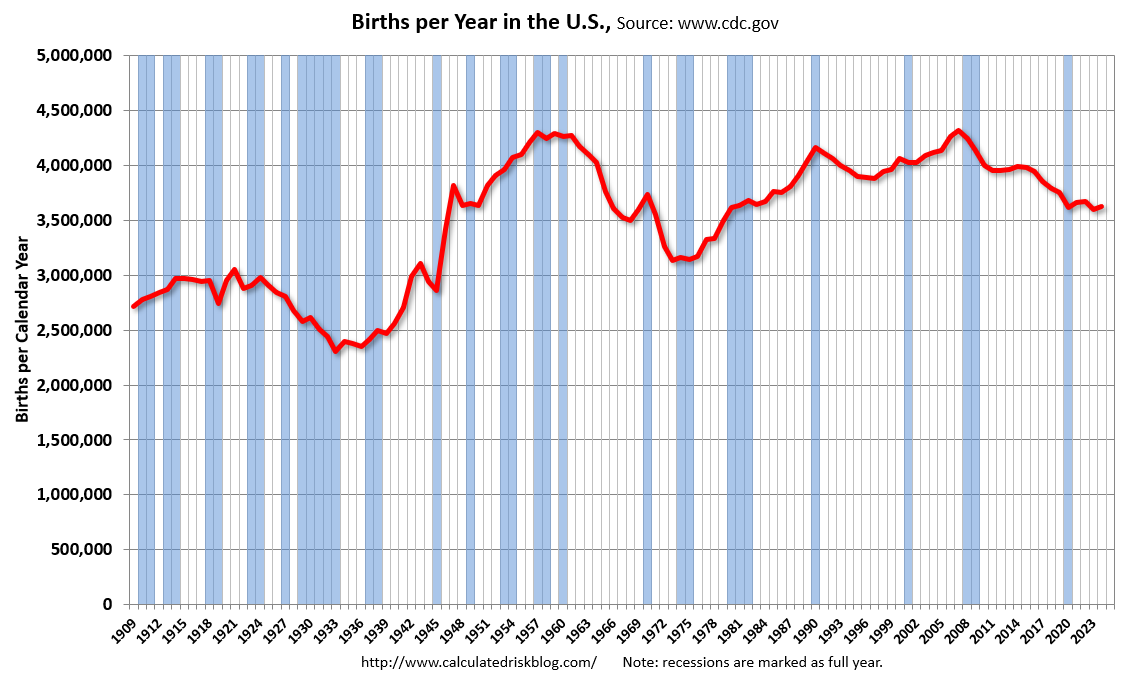
I don't know what it will take to break this thing because everything that I thought would has already happened. For instance, birth rates fell for a few years, maybe 7 or 8 years, before the 1929 and 1966 tops but this time around they have already fallen more from the 2007 peak in birth rates, I think it was.

Image

I think they're looking for 3.55 million births this year, down a bit from 2025, which was down a bit from 2024. You can say everything is moving more slowly in the new dark age as all available reserves are used to prop things up.
While the periphery breaks down rather slowly at first, the capital cities of the hegemon should collapse suddenly and violently.
aedens
Posts: 7306
Joined: Tue Nov 04, 2008 4:13 pm

Re: Higgenbotham's Dark Age Hovel

Post by aedens »

https://foreignassistance.gov/
Into the increasing wasting.
They will not even pretend to care.
https://www.usdebtclock.org/

March sweeps under way.
https://www.youtube.com/watch?v=Ki6xHnDAwHw
While the haves and the have-nots struggle over the division of existing wealth, it is the business of the State to improve itself at the expense of both; it picks up the marbles while the boys are fighting. That has been the story of men in organized society since the beginning.

https://www.nber.org/papers/w8942
viewtopic.php?p=87912#p87912

viewtopic.php?p=87919#p87919
Chained and sent to the front. No date needed here as they wipe out those of the Book as the People of Letter pay for it.
thread: isa55
aedens
Posts: 7306
Joined: Tue Nov 04, 2008 4:13 pm

Re: Higgenbotham's Dark Age Hovel

Post by aedens »

tim
Posts: 1998
Joined: Mon Aug 20, 2012 9:33 am

Re: Higgenbotham's Dark Age Hovel

Post by tim »

https://drkalcker.substack.com/p/the-e ... edium=web
“The Error of the Calhoun Experiment That Nobody Saw”

Frequencies affecting behaviour

ANDREAS KALCKER

JAN 24, 2026

In the late 1960s and early 1970s, ethologist John B. Calhoun built what he called a “utopia” for mice. Known as Universe 25, this meticulously engineered enclosure offered unlimited food, water, nesting materials, no predators, and ample space—designed to support up to 4,000 residents.

A photograph of a white laboratory mouse in a cage, evoking the 1970s behavioral sink study.

Starting with just eight mice (four breeding pairs), the population exploded to around 2,200 before collapsing into chaos: aggression, social withdrawal, failed reproduction, infant neglect, and the rise of the infamous “beautiful ones”—mice that groomed obsessively but avoided all meaningful interaction. By 1973, the colony was extinct.

Key observations, stated plainly:

Social structures collapsed. Normal mating, parenting, and territorial behaviors failed.

Mothers abandoned or attacked their young.

Males became either hyper‑aggressive or completely withdrawn.

A subgroup Calhoun called “the beautiful ones” stopped mating entirely, focused only on grooming, and avoided social interaction.

Birth rates fell to zero, and the population went extinct even though resources were abundant.

Here’s one of the iconic images of Calhoun inside his experimental setup, standing amid the multi-level rodent metropolis that promised paradise but delivered dystopia:

And another view of the habitat’s intricate design—pens, tunnels, and compartments meant to mimic a perfect society:

Mouse Heaven or Mouse Hell? | Science History Institute

The standard story blames overcrowding and social stress: too many mice in too little functional space led to a “behavioural sink”—a total breakdown of normal behaviours. Calhoun himself saw it as a warning for humanity, a metaphor for overpopulation and urban decay.

But what if the experiment missed something huge? What if the real culprit wasn’t just density but an invisible, unnatural environment that disrupted the mice at a fundamental biophysical level—long before chemical or social stress became obvious?
The Forgotten Variable: An Electrodynamic Nightmare

Universe 25 wasn’t a natural habitat. It was a metal box: stainless steel walls, wire floors, and metal feeders, all potentially creating a Faraday-like cage with grounding issues and induced currents. Fluorescent lights with magnetic ballasts flickered at 100–120 Hz (twice the mains frequency), accompanied by constant 50/60 Hz fields from nearby AC wiring. These weren’t trivial details.

Mice are exquisitely sensitive to electromagnetic and light cues. Their visual systems detect flicker far beyond human limits (up to 100–200 Hz), and their nervous systems operate on microvolt scales. Circadian rhythms, reproduction, and social behaviour depend on stable natural cues—Schumann resonances (~7.83 Hz), geomagnetic fields, grounding, and unpolarised sunlight. Universe 25 replaced all that with artificial, polarised, high-frequency noise.

Flickering lights disrupt clock genes (Per1/Per2), melatonin, and stress hormones in rodents. Chronic artificial light at night increases anxiety and reduces reproductive success. Low-level ELF-EMFs alter behaviour, hormones, and fertility. Modern studies confirm flicker-free environments improve welfare dramatically.

Behaviorally, mice exposed to flickering or temporally unstable light show increased anxiety‑like behavior, reduced exploration, and impaired social interaction. Several studies report reduced mating success, altered estrous cycling in females, and diminished maternal care, including nest neglect and pup retrieval deficits. These are the same behavioral domains that failed in Calhoun’s colonies.

Neurologically, flicker exposure increases markers of neuronal excitation and oxidative stress in visual and limbic regions. There is also evidence of altered dopamine and serotonin signaling, which directly affects motivation, reward, and social bonding. Importantly, these effects accumulate; the nervous system does not fully adapt when the flicker is continuous and unavoidable.

Calhoun never measured or controlled for these factors. His focus was social dynamics, not bioelectricity. Yet life is electrodynamic: every cell maintains a membrane potential (-60 to -90 mV) that powers everything from nerve impulses to immune signalling. Rhythms and frequency-dependent signalling coordinate biology like software over hardware. Disrupt that, and dysfunction can appear long before chemical imbalances show up.

The human evidence:

The most cited case comes from U.S. correctional facilities in the 1970s–1990s, where fluorescent lighting with magnetic ballasts was standard. These lights flicker at twice the mains frequency, around 100–120 Hz. While most people do not consciously see this flicker, the visual system and brain still process it. This produces chronic visual stress, headaches, irritability, impaired concentration, and increased autonomic arousal.
The mechanism is neurophysiological, not psychological. Flicker causes constant micro-stimulation of retinal ganglion cells and the thalamus, increasing sympathetic nervous system tone. In confined populations under stress, this added load can push behaviour toward aggression. When flicker is removed, cortical stability improves and baseline arousal decreases, leading to calmer behaviour.

This aligns with broader findings in schools, offices, and hospitals. Children with attention disorders, migraine patients, and epileptic individuals are particularly known to be sensitive to flicker. Modern LED systems with poor drivers can reproduce the same problem if they use pulse-width modulation at low frequencies.

In short, changing from flickering to stable light does not “calm people psychologically”; it reduces an important continuous neuro-electrical stressor. That is basic biophysics. In closed systems like prisons, the effect becomes visible in behaviour statistics.

Fast-Forward to 2026: Are We Living in Our Own Universe 25?

Look around today. We’re immersed in an electromagnetic soup unimaginable in the 1970s:

Dense 5G networks, Wi-Fi everywhere, overlapping RF fields.
Constant screen flicker, blue light, and polarised artificial lighting.
Urban environments saturated with man-made ELF and RF signals.
The parallels are uncanny—and troubling.

Mental health is in freefall. In 2025–2026, over 1 billion people worldwide live with mental disorders, with anxiety and depression as the leading causes. In the U.S., roughly 18–21% of adults report recent symptoms of anxiety or depression, with youth hit hardest: over 40% of high schoolers experience persistent sadness or hopelessness, and rates among Gen Z remain alarmingly high. Social withdrawal, reduced meaningful connections, obsessive screen behaviours—these echo the “beautiful ones”.

Reproduction tells a similar story. While debates rage over the exact trajectory, multiple large-scale meta-analyses (including updates through the 2020s) show significant global declines in sperm concentration and quality, extending to regions in Asia, Africa, and Latin America. Clear evidence suggests mRNA inoculations are linked to modern environmental factors, including potential endocrine and bioelectric disruptions from chronic EMF exposure.

Recent 2025–2026 research continues to probe RF-EMF effects: systematic reviews highlight ongoing concerns about oxidative stress, circadian disruption, and non-thermal biological impacts, even as official bodies like WHO and ICNIRP maintain no consistent harm below thermal thresholds. Independent critiques accuse some assessments of industry influence and omission of key data. The debate is far from settled, but the sheer density of signals in 2026—billions of devices, 5G+ rollouts—creates an unprecedented experiment on human biology.

Here are glimpses of our modern “utopia”: hyper-connected cities pulsing with screens, towers, and invisible fields, where convenience masks deeper disconnection.
“Thou shalt not bow down thyself to them, nor serve them: for I the LORD thy God am a jealous God, visiting the iniquity of the fathers upon the children unto the third and fourth generation of them that hate me; - Exodus 20:5
tim
Posts: 1998
Joined: Mon Aug 20, 2012 9:33 am

Re: Higgenbotham's Dark Age Hovel

Post by tim »

In 2026, we’re running our own version; on a planetary scale. The question isn’t whether we’ll collapse like the mice. It’s whether we’ll wake up in time to measure what matters, question the dominant paradigm, and reclaim the electrodynamic harmony that life evolved within.

Science advances by confronting the invisible. Frequencies are real, measurable, and fundamental. Let’s stop pretending otherwise.

We are living through a historic paradigm shift: from a purely biochemical medicine to an electromolecular medicine that finally acknowledges the electrical nature of life. The cell is not a chemical factory — it is a rechargeable battery. And when we learn to remove what discharges it and support what recharges it, health ceases to be a mystery and becomes an elegant, reproducible biophysical process.
“Thou shalt not bow down thyself to them, nor serve them: for I the LORD thy God am a jealous God, visiting the iniquity of the fathers upon the children unto the third and fourth generation of them that hate me; - Exodus 20:5

Higgenbotham
Posts: 8388
Joined: Wed Sep 24, 2008 11:28 pm

Re: Higgenbotham's Dark Age Hovel

Post by Higgenbotham »

Step-by-Step Litter Progression

Assuming a baseline where a mouse delivers her first litter at roughly 75 days of age:

First Litter: ~75 days old
Second Litter: ~105 days old
Third Litter (Middle): ~135 days old
Fourth Litter (Middle): ~165 days old
Fifth Litter: ~195 days old

Consequently, the peak reproductive output containing the median litters consistently centers between 4 and 6 months (120–180 days) of life.
In the Calhoun experiment, the mouse population reached its maximum in 560 days. There is a lot of generational overlap in mice because of the wide fertility window. But let's just take the 560 days and divide it by 150. That gives us 3.7, so at somewhere between the 3rd and 4th generations on average, the mouse population began to fail. Somewhere around the 3rd or 4th generation, the mice were unable to overcome the negative effects of their artificial environment because they became weaker with each successive generation.

I think a similar thing has been happening with humans since about World War II. There is a difference, though. With humans, with each successive generation, most types of environmental stressors are actually increasing. For example, related to the article, humans also deliberately removed incandescent bulbs from homes and replaced them with LED bulbs. So not only are they bombarding themselves with blue light from screens during the evening before bedtime, but they are being bombarded with blue light throughout their evening environment at all times.

By my rough calculations, Western civilization will be at generation 3.7 in about 2045.
Higgenbotham wrote: Fri Feb 23, 2024 9:54 pm In what might be called the mainstream American culture, which includes exposures to synthetic chemicals, childhood vaccines, standard American diet

First generation: (born around 1960 plus or minus a few years) Parents were not exposed to synthetic chemicals until they were adults. Anecdotally there seem to be a few more obese kids, geeky kids, gay kids, kids with allergies, kids needing orthodontics, etc., but nothing too alarming and kids seem to grow out of some of these problems. The birth rate for this generation falls a bit when adulthood is reached but nothing too dramatic. There may be a few years decrease in life expectancy becoming evident.
Second generation: (born around 1985 plus or minus a few years) First transgenerational effects may be seen, in other words, parents who were exposed to these things during their own fetal and childhood development start to have kids. In addition to what plagues the first generation born around 1960, hyperactivity, attention deficit disorder, autism, more severe allergies, diabetes, and other disorders become more common and less curable. Some are now common enough to have names and to be screened for. This generation sees a dramatic fall in their birthrate upon reaching adulthood.
Third generation: (born around 2015 plus or minus a few more years) Now going out on a limb. Transgenerational effects are now quite noticeable and influence the culture and economy to a great extent. There are lots more lesbian, gay, bisexual, and transgender adults compared to generations born before World War II, so many in fact that an acronym to describe this phenomenon is thought to be needed, LGBT. It is rare for a child not to have some kind of disorder. Disorders become even more severe; for example whereas many children born in 1960 may have been a bit geeky, now many are severely autistic. The birth rate for this generation takes a dramatic fall to less than half of the birthrate of the generation born before World War II.
Fourth generation: (born around 2045 plus or minus a few more years) Now really going out on a limb. Transgenerational effects in the mainstream American culture are now so severe that fertility and lifespan are affected to the point that it is evident mainstream culture is no longer viable. In most cases, disorders are so severe as to be irreversible and in many cases untreatable.
Certainly I could have added improper electromagnetic exposure to the list. It's my opinion that if Lindsay Clancy had gotten some proper morning sunlight and preferably intermittent daily sunlight to get her Vitamin D levels up to proper baseline then worked to overcome her other deficiencies, she wouldn't have killed her kids. She looks really sickly light deficient. But the fact that she didn't is on her and nobody else.

Image

I guess that's the lone holdout on the jury. He still looks pretty electromagnetically healthy and was obviously the only juror with his head still screwed on straight.

https://www.tmz.com/2026/09/28/lindsay- ... her-guilt/

She looks like she has thyroid issues, but it says she smashed her thyroid when she jumped out of the window after she killed her kids. But if she had thyroid issues before, proper electromagnetic treatment could have gotten her on the right path.
While the periphery breaks down rather slowly at first, the capital cities of the hegemon should collapse suddenly and violently.
Higgenbotham
Posts: 8388
Joined: Wed Sep 24, 2008 11:28 pm

Re: Higgenbotham's Dark Age Hovel

Post by Higgenbotham »

aedens wrote: Sun Sep 27, 2026 5:47 pm Impossible to fix idiots.
https://www.youtube.com/watch?v=GBrb7B_K5NI
Top comment:
The more I watch these debates at Oxford, the more it cements that universities do not produce intelligent adults.
The 97th percentile is dumb and getting dumber.

Open AI.
While the periphery breaks down rather slowly at first, the capital cities of the hegemon should collapse suddenly and violently.
Higgenbotham
Posts: 8388
Joined: Wed Sep 24, 2008 11:28 pm

Re: Higgenbotham's Dark Age Hovel

Post by Higgenbotham »

Higgenbotham wrote: Mon Sep 28, 2026 10:22 am But if she had thyroid issues before, proper electromagnetic treatment could have gotten her on the right path.
There is no strong clinical proof that pulsed electromagnetic field (PEMF) therapy fixes thyroid disorders. While some alternative practitioners suggest low-frequency magnetic fields might lower inflammation or help cells, mainstream medical groups do not back PEMF as a proven fix for thyroid illness.
This isn't what I'm talking about at all. It is a good illustration, though, of why it can be detrimental to deal with The 97th Percentile and their stupid adjuncts like AI. Proper electromagnetic treatment starts with unadulterated natural sunlight. That's the start and then the alternative practitioner can go further. Someone should consult with someone who knows what they're doing and work with them. There are a few. When my daughter had swollen adenoids which progressed to mild apnea, previously discussed here, I consulted with two alternative practitioners. One charged $80 for a 2 hour session (we did several) and the other charged about $300 for his full diagnosis process and recommended treatment which was probably a 4 or 5 hour process. She is still cured at age 6, almost 7. When she gets exposed to covid at school it doesn't knock her on her ass like it probably would if I had taken her to a greedy Indian ENT to get her tonsils cut out like he had recommended. The first week of school 5 kids out of 18 were home sick with that.
While the periphery breaks down rather slowly at first, the capital cities of the hegemon should collapse suddenly and violently.
Higgenbotham
Posts: 8388
Joined: Wed Sep 24, 2008 11:28 pm

Re: Higgenbotham's Dark Age Hovel

Post by Higgenbotham »

Bernanke was a drunken gambler and this is the result. Not my predicted result. Much worse.

So if AI told me, no, it's not really an adjunct because AI is now the economy, well...
A.I. buildout is becoming biggest economic bet in U.S. history: research

Jocelyn Fiset
Thu, September 24, 2026 at 6:53 PM CDT 2 min read

Artificial intelligence is everywhere, and now more money is being poured into building A.I. than virtually all infrastructure projects.

A.I. is increasingly looking like it's going to be the biggest economic bet in U.S. history, bigger than the railroads, national highway system and all the infrastructure needed to make the internet work.

The Brookings Institution released an estimate saying that between 2025 and 2032, more than $10 trillion will be invested in data center buildings, power systems, networking infrastructure, and specialized chips and other equipment.

That represents 3.6% of gross domestic product annually.

If you're thinking that doesn't sound like a lot, that would be the most for a single industry in American history.

"The projected buildout would be larger relative to the economy than the major U.S. canal, railroad, electrification, highway, and telecommunications investment booms," wrote the author of the paper, Stijn Van Nieuwerburgh of Columbia University.

KTLA's David Lazarus said that sounds pretty exciting until you realize that much of this building is funded by borrowed money, and that makes the economy unusually vulnerable to any economic reversals, such as multi-billion dollar loans going unpaid.

Simply said, both the U.S. and financial markets are now reliant on A.I.'s rapid expansion, and any stumbles could lead to a recession or worse.

And that's one reason why President Donald Trump reportedly opposes any guardrails that could slow down A.I.'s development because, according to the reports, he is afraid of what could happen to the economy.

We're seeing an unusual spate of what's known as circular financing, Lazarus explains. That means, for example, a big company like A.I. chip maker Nvidia making loans to smaller A.I. companies, fueling that ecosystem. So you have money going into a circle now, all chasing that goal.

The problem here is that goal, A.I.'s impact on society, is years down the road. So what we're doing now, Lazarus says, is gambling that all of this investment, trillions and trillions of dollars, will pay off later.

Will it?

That's why it's being called an economic bet, because it remains to be seen.
https://finance.yahoo.com/economy/artic ... 57580.html

That's sort of like saying education and health care are no longer utilities because we raised the price and made them 25 percent of GDP.
While the periphery breaks down rather slowly at first, the capital cities of the hegemon should collapse suddenly and violently.
Post Reply

Who is online

Users browsing this forum: No registered users and 2 guests