Pols will do zero. They paid for it lock stock and barrel.
They already had the electron microscope image and what was actually cleaved in.
The splicing also included HIV to inhibit recovery.
Every knew. You can blame whatever molek or ba al or astarte and as the water wheat weather alludes them to the season
that will reap what was told long ago.
No gas chambers needed for genomic genocides and much worse seen given the bent of minds.
Before dragonfly we knew as His servants with the Remnant ponder the times while the Watchers His servants Man the Wall alone.
They sent it over the Wall just as we spared the Yazidi facing extinction that day.
Welcome and do seek Him. He will never abandon you.
1. unbridled enthusiasm
2. mass confusion
3. sudden disillusionment
4. search for the guilty
5. punish the innocent
6. rewarding of the non-participants
7. see step one
https://www.youtube.com/watch?v=kJhFz9jaoM0
Higgenbotham's Dark Age Hovel
-
Higgenbotham
- Posts: 8380
- Joined: Wed Sep 24, 2008 11:28 pm
Re: Higgenbotham's Dark Age Hovel
There are many hypotheses about the explosion of depression and anxiety out there, especially for young adults under
1:08
30. The one thing that nobody's in doubt about, however, is that these problems are real. The numbers just don't lie.
1:15
Depression has about tripled over the past 15 years for young adults, and anxiety has doubled. The question is
1:22
why? People have posited that it's a problem of a different generation. That boomers wrecked everything. They made
1:28
the houses expensive. They ruined the environment. And a lot of boomers will say, "No, the problem is it's the
1:33
attitude and it's the the fragileness of young people today." None of those
1:38
explanations really hold water. People have been complaining about different generations for thousands of years. The
1:44
real reason that we actually find behind the epidemic of depression and anxiety is the answer to the question, does your
1:51
life have meaning? For many years, decades, generations, the answer for
1:57
almost everybody was yes. People had a strong sense of meaning in their lives. But then something happened. The
2:03
percentage of the population, especially young adults, saying my life feels meaningless. It started to creep up and
2:09
then and then explode. Something happened very recently, really only in
2:14
the past 15 years, that made life feel meaningless. And meaninglessness, the
2:19
lack of meaning in life, lies behind the explosion of depression and anxiety.
2:25
So some people find meaning more easily than other people do. The number one
2:30
predictor of your life feeling meaningful is is living your life in
2:35
real life. It's relationships. It's living kind of in the old way. As a matter of fact, it wasn't that long ago
2:42
that almost nobody said, "My life feels meaningless." But having distance between you and other people, or having
2:48
technological mediation between you and other people, for example, having a screen between you and your friends, you
2:55
and your loved ones, you and your family. Well, that changes life. It takes it from in real life to something
3:00
more like, I don't know, a simulation of real life, which is exactly what a lot of young people say today. When I
3:07
interview them, they'll say, "My life feels fake. It feels like something's missing. It feels like I'm living in a
3:14
simulation."
https://youtu.be/WP3wl1rsXjg?t=62We cured boredom — and created a meaning crisis | Arthur Brooks: Full Interview
Big Think 53,388 views Aug 7, 2026
While the periphery breaks down rather slowly at first, the capital cities of the hegemon should collapse suddenly and violently.
-
Higgenbotham
- Posts: 8380
- Joined: Wed Sep 24, 2008 11:28 pm
Re: Higgenbotham's Dark Age Hovel
I discussed the precursor problem which set the stage for what's described in the post above in this Dark Age Hovel a few years ago.
Higgenbotham wrote: Sun Dec 25, 2022 6:28 pmHiggenbotham wrote: Wed Dec 14, 2022 10:32 pm Another thing that relates to that is there is a moral code in rural areas versus a moral code in urban areas. I witnessed this conflict as I grew up. My grandparents spent their entire lives in a rural area; my parents spent until age 18 in a rural area and 34 working years in a city. They couldn't wait to get the hell out. As kids, my sister and I went back to their home every year and were immersed in rural culture for a week. I think part of the huge divide in this country has to do with the fact that more and more families have spent several generations in the city and have not been exposed to rural culture in any meaningful way at all, as my sister and I were.Higgenbotham wrote: Sun Dec 25, 2022 1:06 am Now instead of my sister feeding me information about "Q" or something similar, she asks me questions like, "You've been here (the acceptance stage of collapse) a long time, what do you think about...?"
When someone moves along from denial to acceptance of collapse, I think it is natural to start looking at the quality of connections around them. A couple months ago, my sister asked me why I thought she didn't have any true friends. Previously, she had only said that people she knew had changed and she had lost contact.
I said there are two opposite modes of living in the United States. The first is an expectation that you will spend your entire life in one area with other people who will spend their entire lives in that area. The second is an expectation that you will go to high school in one place, college in another place, then career in several places (no longer at one company) with sole focus on that. Everything else is something in between. The first mode engenders real connections while the second mode engenders transactional relationships. An example of a transactional relationship would be something like, "I have a buddy who is also 420 friendly. He finds me really good dope cheap and I fix all his computers." The best example of a transactional encounter I can think of is prostitution. Also, in a big city, encounters are briefer. That's not to say there isn't some overlap.
I told her in the second mode of living, people are taught from an early age to look to the next step in their progression and to primarily engage in transactional relationships as a means to get to that next step. A high school kid might be told to be friendly to the teachers because they will be writing college recommendations or whatever. They would not be encouraged to be friendly to teachers they genuinely like and not be friendly to teachers they genuinely do not like. And so on when the kid gets to college. I should add as an aside that girls are better at that than boys. I told her that while coping with the stress of getting from step to step, people who find themselves in the same boat will bond somewhat. But they know those bonds are likely temporary and will be broken when they get to the next step unless there is a practical reason to keep them. I also told her that people who have lived in transactional relationship mode for several generations do not even know how to live differently and can't. Many do not understand what a real connection is.
I would also add that high tech is making people more and more into transactions versus customers. Google is the best example I can think of.
Higgenbotham wrote: Thu Feb 02, 2023 9:49 pm During the descent into a dark age, it seems the social breakdown comes first, followed by the economic breakdown. One of the catalysts to the recent social breakdown was to uproot people from their established places and make their existence nomadic. This was promoted by slogans such as "you need to go where the opportunities are" or "get an education and a better life", things like that. This process sort of fed upon itself; for example, people are uprooted and, as a result, spend more dollars with corporations whose business models are indirectly based on uprooting people, which in turn results in even more people being uprooted. As an example, let's say you own or work for the general store in a small town, a unique store. You are probably going to be working and living in that small town your whole life. But if Wal-Mart comes into town and uproots that store, then you are likely to become one more corporate nomad moving from place to place and frequenting businesses whose names you recognize. I referred to that process a bit here:
Higgenbotham wrote: Wed Dec 14, 2022 10:32 pm Another thing that relates to that is there is a moral code in rural areas versus a moral code in urban areas. I witnessed this conflict as I grew up. My grandparents spent their entire lives in a rural area; my parents spent until age 18 in a rural area and 34 working years in a city. They couldn't wait to get the hell out. As kids, my sister and I went back to their home every year and were immersed in rural culture for a week. I think part of the huge divide in this country has to do with the fact that more and more families have spent several generations in the city and have not been exposed to rural culture in any meaningful way at all, as my sister and I were.During the early stages of this breakdown, many of the new corporate nomads gathered together in suburbs of large cities and, being first generation nomads, attempted to re-create the kinds of social bonds that were present in the places they came from. This worked pretty well for a time, until those people died off and the second and third generations stopped doing this. I think this was described best in a book called Bowling Alone and thought it had been discussed here, but don't find anything offhand. I'll continue to look for that.Higgenbotham wrote: Sun Dec 25, 2022 1:06 am I said there are two opposite modes of living in the United States. The first is an expectation that you will spend your entire life in one area with other people who will spend their entire lives in that area. The second is an expectation that you will go to high school in one place, college in another place, then career in several places (no longer at one company) with sole focus on that. Everything else is something in between. The first mode engenders real connections while the second mode engenders transactional relationships. An example of a transactional relationship would be something like, "I have a buddy who is also 420 friendly. He finds me really good dope cheap and I fix all his computers." The best example of a transactional encounter I can think of is prostitution. Also, in a big city, encounters are briefer. That's not to say there isn't some overlap.
I told her in the second mode of living, people are taught from an early age to look to the next step in their progression and to primarily engage in transactional relationships as a means to get to that next step. A high school kid might be told to be friendly to the teachers because they will be writing college recommendations or whatever. They would not be encouraged to be friendly to teachers they genuinely like and not be friendly to teachers they genuinely do not like. And so on when the kid gets to college. I should add as an aside that girls are better at that than boys. I told her that while coping with the stress of getting from step to step, people who find themselves in the same boat will bond somewhat. But they know those bonds are likely temporary and will be broken when they get to the next step unless there is a practical reason to keep them. I also told her that people who have lived in transactional relationship mode for several generations do not even know how to live differently and can't. Many do not understand what a real connection is.
Also, during the early stages of this breakdown, there were economic losers and beneficiaries. The beneficiaries were the corporations who could cookie cutter their outlets across a previously interesting and varied landscape, producing the forlorn, bland, and ugly architectural landscape that now exists across America. McDonalds perhaps being one of the first and best examples. During the heyday of the expansion of McDonalds, along came the "great investors" who realized they could make a lot of money investing in this concept, people like Warren Buffett and Peter Lynch. Lynch described what he called the "ten-bagger" which was a stock where you could invest a dollar and that investment would multiply quickly to 10 dollars as these corporations cookie-cuttered their outlets across the country. Expanding in this way made a corporation hungry for capital and there was a class of people who got rich providing it, including many corporate nomads who recognized what was happening from observing their own lives. However, many more missed the boat, even though it was somewhat obvious.
It now appears this stage has been winding down for some time. Again, there are those who recognize this. I posted this awhile back for another reason, but will repeat it here with the relevant part underlined:
The question is, given the end of this era, what has been coming and is now well over over the horizon? I think for the answer to this we have to look at the early history of Bill Gates and Microsoft.Higgenbotham wrote: Thu Dec 29, 2022 6:05 pmhttps://www.msn.com/en-us/news/opinion/ ... 259be365f6Trump-supporting billionaire Home Depot founder says 'nobody works anymore' because of 'socialism'
Many reasons have been thrown about as to why the U.S. is still in the midst of a historic labor shortage, including a decline in fertility rates, older workers retiring in droves, the lingering effects of COVID-19 infections, and of course, worker demands for fairer pay and more expansive benefits.
But Bernie Marcus, the billionaire co-founder of Home Depot, says it’s really simple: People just hate capitalism now. Because of “socialism,” he said in an interview with the Financial Times published Thursday, “nobody works. Nobody gives a damn. ‘Just give it to me. Send me money. I don’t want to work—I’m too lazy, I’m too fat, I’m too stupid.’’
In today’s business climate, Home Depot may have been able to only open 15 or 16 stores, Marcus said, compared to the 2,300 locations the retailer currently has scattered around the U.S. For Marcus—an unabashed supporter of former President Donald Trump, often to his own company’s chagrin—the reasons behind today’s unfavorable environment include the current administration and the “woke” establishment’s involvement in business.
In the wide-ranging interview, where Marcus—worth over $5 billion according to Bloomberg—touched on everything from his reputation as a prolific philanthropist to his inclination for Milton Friedman’s business-first interpretation of economics, the former CEO lamented capitalism’s slow demise in the U.S. while criticizing the “woke people” he thinks are eradicating free speech.
While the periphery breaks down rather slowly at first, the capital cities of the hegemon should collapse suddenly and violently.
-
Higgenbotham
- Posts: 8380
- Joined: Wed Sep 24, 2008 11:28 pm
Re: Higgenbotham's Dark Age Hovel
Scott Galloway commenting on what happens when you say people's favorite bubble stocks are overvalued.
https://youtu.be/VxpxLIuPxLA?t=3132
It is countercultural. It's not like it is, it is.I'll come back [laughter] to that because what I will say is I think a lot
52:14
of that is fear of shame. And that is I put out a post I think five or six years
52:20
ago where I said oil and Snap and Wework were just dramatically overvalued.
52:26
And I have never seen that kind of push back, anger, character assassination,
52:34
saying I'm an evil person as I registered from the the valley who had
52:39
all, you know, marked their portfolios. I I just couldn't get over it. It's as if I said that their parents
52:46
were war criminals or something. I've never So, I think a lot of a lot of what you endure, quite frankly, is you have
52:52
to have thick skin because you can you can lose a ton of other people's money promoting a stock, but God help
52:59
you if you start shit posting a stock. You know, everybody, it feels like what
53:04
I've I can't believe the hate you get and when anyone questions a stock, it's like it's almost like it's
53:09
countercultural. You're not you're being non-patriotic.
https://youtu.be/VxpxLIuPxLA?t=3132
This is the first time I've mentioned anything related to Jim Chanos in this Dark Age Hovel.Legendary Short Seller: Fraud Is Hiding Behind Record Highs
Prof G Markets
261,117 views Jul 31, 2026
While the periphery breaks down rather slowly at first, the capital cities of the hegemon should collapse suddenly and violently.
Re: Higgenbotham's Dark Age Hovel
Volcker as the line snaked around the corner at the plasma center then will be rather the view.
https://commons.wikimedia.org/w/index.p ... d=16122807
Uniparty has one goal now.
https://substackcdn.com/image/fetch/$s_ ... 6x328.jpeg
https://victimsofcommunism.org/curriculum-chapter-2/
One comparison was they are brick stupid on market conditions.
I left it alone because early is wrong in the pagans walking in circles brain pan.
https://cms.zerohedge.com/s3/files/inli ... k=nS6XFo8R
https://commons.wikimedia.org/w/index.p ... d=16122807
Uniparty has one goal now.
https://substackcdn.com/image/fetch/$s_ ... 6x328.jpeg

https://victimsofcommunism.org/curriculum-chapter-2/
One comparison was they are brick stupid on market conditions.
I left it alone because early is wrong in the pagans walking in circles brain pan.
https://cms.zerohedge.com/s3/files/inli ... k=nS6XFo8R
-
Higgenbotham
- Posts: 8380
- Joined: Wed Sep 24, 2008 11:28 pm
Re: Higgenbotham's Dark Age Hovel
https://theknowledgehub360.quora.com/Ar ... ent_type=3I was born and raised in the rural South, around Louisiana and the Carolinas. To be honest, some of these places feel like the third world now, no good jobs, terrible schools, crime, and awful healthcare. It wasn't always like this, though. I remember the early '80s when there were still plenty of factory jobs that paid a decent living. When they shut down and moved away, it left entire communities completely destitute, right before the crack epidemic hit. Enlisting in the military was my ticket out, giving me the chance to travel and see the world as both a service member and a civilian. Sure, US poverty might not look exactly like Haiti or a Brazilian favela, but in truth, it really isn't that far off.
I couldn't have said it better myself. The periphery, and the rural South is part of it, breaks down rather slowly at first, but the capital cities of the hegemon should collapse suddenly and violently.
While the periphery breaks down rather slowly at first, the capital cities of the hegemon should collapse suddenly and violently.
-
Higgenbotham
- Posts: 8380
- Joined: Wed Sep 24, 2008 11:28 pm
Re: Higgenbotham's Dark Age Hovel
https://x.com/HedgieMarkets/status/2081534588485296565AI companies are bulk-buying rare books, scanning them through high-speed machines that cut the spines off, and shredding the originals. A service called ISBNdb facilitates orders of up to a million books and keeps buyers anonymous. Pre-2022 books are premium because they're free of AI-generated text. A federal judge ruled the practice is fair use because eliminating the original means only one copy exists at a time. Anthropic hired the former head of Google Books partnerships to obtain "all the books in the world."
My Take
This got to me. A bookseller told 404 Media that rare books with almost no surviving copies are being fed into this pipeline. Books that survived wars, fires, and centuries of handling are being shredded so an AI can learn to write a better marketing email.
ISBNdb's website literally says "'AI company destroys two million books' is not a headline that generates sympathy," and they still built an entire business around making it happen quietly. They offer NDAs as a feature. They coach clients to call it "digital preservation."
I've covered AI companies scraping the internet, torrenting libraries, and stealing music. This is worse because it's irreversible. You can re-upload a website. You can reprint a bestseller. You can't replace the last three copies of an 18th-century botanical text once someone shreds them for training data. And the judge said it's legal. So it's going to accelerate.
"We shred rare books and offer NDAs so nobody finds out" is a legitimate business model in 2026. What a timeline.
https://mashable.com/life/ai-companies- ... ining-data
While the periphery breaks down rather slowly at first, the capital cities of the hegemon should collapse suddenly and violently.
-
Higgenbotham
- Posts: 8380
- Joined: Wed Sep 24, 2008 11:28 pm
Re: Higgenbotham's Dark Age Hovel
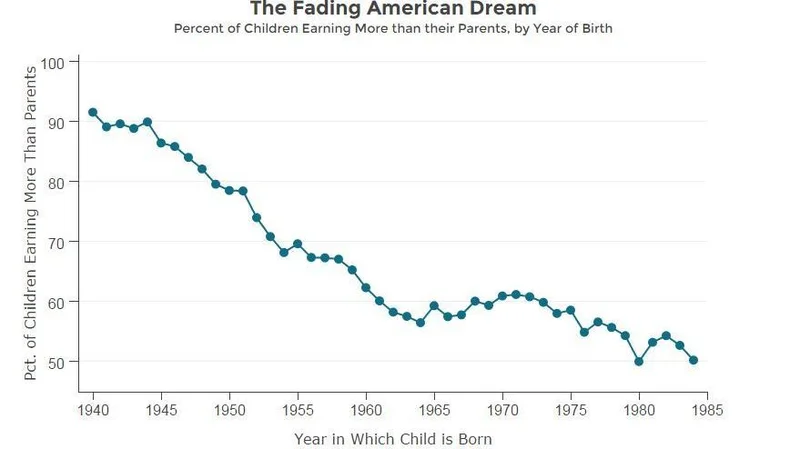
I'd suspect the numbers went way below 50 percent after 2014. There have been no updates to this data since then that I can find. Basically, the American Dream was over around 2011 when Bernanke went wild with the printing press and the world, led by the US, was ushered into a new dark age, by my reckoning anyway.
While the periphery breaks down rather slowly at first, the capital cities of the hegemon should collapse suddenly and violently.
-
Higgenbotham
- Posts: 8380
- Joined: Wed Sep 24, 2008 11:28 pm
Re: Higgenbotham's Dark Age Hovel
Business
H-E-B produce supplier shutters San Antonio production, cutting 166 local jobs
A failed buyout is forcing the national produce grower to shut down.
By Zachary-Taylor Wright,
Trending Digital Reporter
Aug 11, 2026
https://www.mysanantonio.com/business/a ... 377724.phpMike Zelkind, co-founder of 80 Acres Farms, stands in front of a row of crops in the facility in Cincinnati in 2018. The company was considered a leader in this field of vertical farming", but is now shutting down across the country.
Another indoor vertical farming operation bites the dust. Nope, indoor farming isn't going to save us.
Meanwhile, around the world, it's getting tougher outdoors too. This article is from England.
https://www.bbc.com/news/articles/c0qvw91ejp1o'We might as well not bother growing things'
25 July 2026
Becky Yeomans
North West
Olly Harrison says this year is the driest he has ever known (photograph caption from article)
"We might as well not bother growing things and leave the farms empty."
That is the bleak position facing arable farmer Olly Harrison following three heatwaves already this year.
Some of his colleagues fear increasingly extreme weather, including prolonged dry spells and flooding, is forcing them to seriously question whether their industry is sustainable.
After a dry spring, the north-west of England continues to have extremely low rainfall.
Harrison, from Tarbock, near Prescot on Merseyside, told the BBC the recent hot weather had reduced his crop yield.
"We have up to a half less to sell and we have to process it in the yard to make it sellable, like wetting them up and increasing the quality," he explained.
These additional processes all cost time and money - reducing profit margins.
Harrison continued: "Last year it was really dry, 2024 was ridiculously wet, there's no clear pattern other than extremes.
From a post earlier this year:
Higgenbotham wrote: Thu Apr 09, 2026 2:45 pm The other aspect of this, besides soil, is weather extremes. This year it was in the upper 90s on March 15. During the early morning hours of March 17, it was 29 degrees. As the cold air came in, winds were brisk, which didn't help. Many gardeners in this area lost all of their cold sensitive crops or they were badly damaged.
This is when it can be advantageous to be working on a small scale. I covered my tomatoes with blankets (they had to be put over stakes so that the blankets wouldn't touch the plants). Only 3 were damaged out of 28. In an open field, everything would have been lost.
While the periphery breaks down rather slowly at first, the capital cities of the hegemon should collapse suddenly and violently.
Re: Higgenbotham's Dark Age Hovel
https://charleshughsmith.substack.com/p ... otted-away
Our Foundations Have Rotted Away While the Bubble Benefited the Top 10%
If you want to argue, argue with the data. Sorry, the data won.
I narrate key points in my post “While We Focused on Fripperies, the Foundations Have Rotted Away”
That's an incredible concentration of the gains in two overlapping cohorts: the top 10% of households and those 55 and older.
Actually, for the bottom 90% of American households, overseas travel is at best optional. Nobody seems to be asking questions such as: what kind of society do we end up with if young people no longer have an interest in raising families or buying homes while devoting their earnings to visiting the Stans? What kind of society celebrates luxury travel while 92% of households forego medical care because they can't afford it?
The obvious answer is a society whose foundations have completely rotted away while we focused on fripperies funded by asset bubbles. If you want to argue, argue with the data. Sorry, the data won.
“Thou shalt not bow down thyself to them, nor serve them: for I the LORD thy God am a jealous God, visiting the iniquity of the fathers upon the children unto the third and fourth generation of them that hate me; - Exodus 20:5
Who is online
Users browsing this forum: No registered users and 14 guests