
Excellent series of March 5th write-up's Higgenbotham! Always enjoy your up-front and n-depth conversation with people you meet on the street. Thanks, I needed that (those)! Carry on.
Best Regards,
Iceman
A few weeks ago I ran across a chart of these planetary boundaries that was updated for 2025.Higgenbotham wrote: Fri Jan 02, 2026 4:33 pmhttps://esemag.com/hazardous-materials/ ... boundariesChemical production outpacing world’s ability to understand the risk, study warns
Feb 16, 2022
With global chemical production increasing 50-fold since 1950 — and projected to triple again by 2050 compared to 2010 — its aggressive pace may outstrip society’s ability to adequately assess and monitor the risk, pushing the planet to the brink, a new study suggests.
There are an estimated 350,000 chemicals or mixtures on the global market, with nearly 70,000 registered in the past decade, and another 30,000 that have only been registered in emerging economies where chemical production has jumped beyond adequate disposal capacity, warns a team of 14 international researchers in the study published by the American Chemical Society.
The emergence of more and more new chemicals that aren’t fully understood puts humanity out of a “safe operating space,” the authors say.
“Chemical pollution has the potential to cause severe ecosystem and human health problems at different scales, (but also to alter vital Earth system processes on which human life depends),” begins the study’s introduction in the scientific journal Environmental Science and Technology.
Plastic production alone increased 79% between 2000 and 2015, the team found.
The range of manufactured chemicals, from plastics to pesticides, industrial chemicals, antibiotics and other pharmaceuticals, has pushed Earth beyond one of what scientists interpret as nine planetary boundaries that act as markers for the Earth’s health. These boundaries include greenhouse gas emissions, the ozone layer, forests, freshwater and biodiversity. However, chemical pollution may have breached the boundary referred to as “novel entities,” or things made by humans and introduced into the environment.
The new study, in part, reviews the evolution of the scientific discussion related to the planetary boundary for novel entities. The scientists acknowledged the data was sparse in many areas, but said the weight of evidence indicated a breach of the planetary boundary.
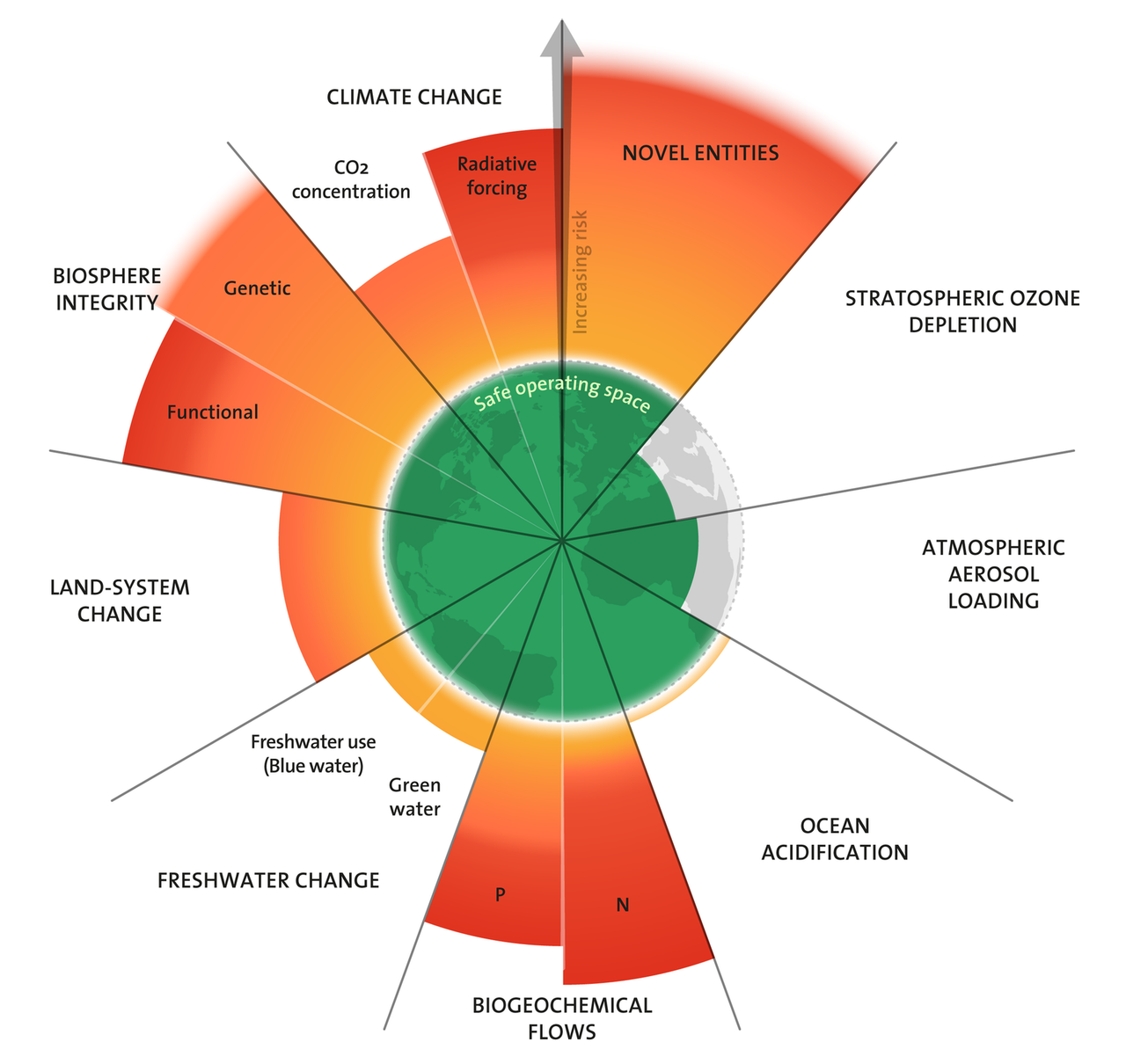
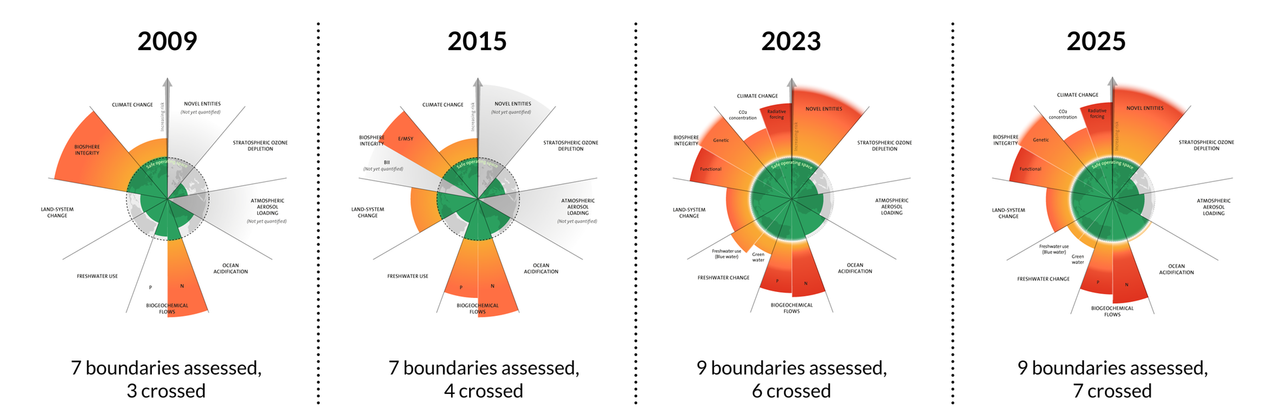
This is probably the greatest overlooked risk of our time. Some say that lead contributed to the fall of the Roman Empire. What we are dealing with is probably hundreds of times more serious than lead. It has the potential to extend the coming dark age for a long time.Novel entities: Technological developments introduce novel synthetic chemicals into the environment, mobilize materials in wholly new ways, modify the genetics of living organisms, and otherwise intervene in evolutionary processes and change the functioning of the Earth system. The amount of synthetic substances released into the environment without adequate safety testing places novel entities in the high-risk zone.
This is typical of how The 97th Percentile operates and has operated - with a new twist.Do some think AI is being used as an excuse to reduce the size of unaffordable and excessive corporate, nonprofit and government bureaucracy?
Yes, many analysts, business leaders, and critics believe that Artificial Intelligence (AI) is being used as a convenient justification—or "excuse"—to reduce the size of, and cut costs within, large corporate, nonprofit, and government bureaucracies.
While AI holds the potential to genuinely improve efficiency by automating routine tasks, it is frequently cited as the reason for layoffs and restructuring, allowing organizations to trim staff under the guise of technological advancement.
Here is a breakdown of how AI is being used to address bureaucratic bloat across different sectors:
1. Corporate Sector: "Efficiency" as a Cover for Downsizing
Layoffs and Restructuring: Companies are utilizing AI as a rationale for restructuring, often aimed at reducing payroll and increasing margins.
"AI Excuse": Some argue that AI is used as a cover for cutting costs after years of overspending on infrastructure or overhiring. Data indicates that while AI is cited in many job cuts, it accounts for a smaller percentage of total layoffs compared to general economic conditions, suggesting it is a "convenient" justification for cost-cutting.
Flattening Hierarchies: AI is being used to automate middle-management tasks, leading to flatter organizational structures where fewer managers are needed.
2. Government Bureaucracy: The "Demand Machine" vs. Cost Cutting
The "DOGE" Effect: Internal, anecdotal reports suggest that in some government contexts, particularly those influenced by initiatives like the Department of Government Efficiency (DOGE), AI is being deployed with the specific aim of reducing staff in administrative roles.
Streamlining Processes: AI is being used to tackle massive bureaucratic tasks, such as analyzing millions of lines of regulations, identifying outdated, redundant, or inefficient reporting requirements, and accelerating permit processing (e.g., in San Francisco and Honolulu).
The Counter-Argument: Some researchers argue that AI is more of a "demand machine" in government—it makes it easier for residents to request services, which increases workload rather than reducing it, despite the promise of smaller bureaucracy.
3. Nonprofit Sector: Doing More with Less
Mitigating Resource Scarcity: Nonprofits are increasingly using AI to handle mundane tasks, allowing them to maintain, or reduce, staffing levels while still meeting the demands of their missions.
Efficiency vs. Capability: There is a debate about whether AI truly helps nonprofits, as it can, in some cases, shift the focus from genuine impact to increasing the speed of output, which can lead to a "hollowed-out" organization that is faster but less effective.
Perspectives on the Trend
Proponents: Argue that AI allows for the elimination of tedious, routine, and bureaucratic work, ultimately making institutions more agile and productive.
Critics: Argue that it is a "scam" by private equity and leadership to "torchy" employee populations, leaving organizations "a shadow of themselves". Others argue that AI does not actually reduce bureaucracy, but rather makes it more "persecuting" by increasing surveillance and reducing human accountability.
In summary, AI is being used as a tool to justify reducing the size of bureaucracy. Whether this leads to necessary "right-sizing" or, as some fear, to the dismantling of necessary, human-centered services, remains a subject of intense debate.
Given that manipulation and fraud are the biggest businesses in America today, along with the fact that any crash that happens here will be happening in and, at the same time, very likely accelerating the decline, the pattern of the crash will change in unknown ways. I'm trying to think about what that might look like.Fullmoonn wrote: Sat Feb 28, 2026 11:59 pmIt's almost as though some people already know about this and are timing/front running/trying to control it. As they pretty obviously are. HahaHiggenbotham wrote: Sat Feb 28, 2026 5:26 am The US and Israel have attacked Iran, just as a Puetz crash window is opening up early next week.
The brunt of the crash happens after the lunar eclipse passes. The coming lunar eclipse is March 3.aeden wrote: Sun Jul 28, 2019 6:07 am As we know H we cover it all, well we try, and really this is simply a gut check to what others could care less about or basically cannot.
Several years back, a cycle watcher named Steve Puetz attempted to see if eclipses and market crashes were somehow related.
He studied eight of the greatest crashes in financial history, from the Holland Tulip Mania of 1637 to the Nikkei of 1990. He found that market crashes tend to occur near full moons, and that the greatest number of crashes start after the first full moon after a solar eclipse, when that full moon is also a lunar eclipse. Puetz found that all eight crashes occurred six days before to three days after a full moon that occurred within six weeks of a solar eclipse. The odds of that being a coincidence, Puetz calculated, are less than 1 in 127,000. Puetz was not saying that so-called "Puetz windows" always lead to crashes, but that if a crash is going to occur, a Puetz window would be the likely time frame in which it would happen.
Higgenbotham wrote: Sat Dec 31, 2016 10:24 pm https://www.arthurdemarest.com/collapse ... s-today-2/
So, you know, we're collapsing. But I'm not just a grumpy old man, we're collapsing. Although it sounds like it. I'm an expert on the collapse of 18 civilizations and we're collapsing. We've got everything. We've got every single fucking cause of collapse you could want except radical climate change and that's beginning. So, but as I've told you, don't worry about global warming. We won't make it far enough for that to be a problem. I think the wars are going to be the end of everything but only because the infrastructure's so vulnerable because of hypercoherence and technology it's also fragile.
Higgenbotham wrote: Thu Mar 05, 2026 11:33 pm Related to the above, over at my daughter's school there is a professor who picks his granddaughter up every day. I don't know his age, but some of the dates he mentioned recently would give someone a clue. His hair and beard are snow white and decades of stress shows on his face. He mentioned some months ago that he is a professor at Texas State.
This week I began having more detailed conversations with him. He said the quality of University level education has been declining since 1989 when he started teaching, as well as the quality of the students. He is a business professor. Then he brought up something that only fully got my attention later. He said that in the late 1990s he had been a professor at Rice University. There was a student there from a wealthy and politically connected family in Argentina who he had failed in his class. After posting the failed grade, he was called into the office of the Chancellor (I think I have the term right as he told it to me). The Chancellor told the professor that he was going to change this student's grade and pass him. He told the Chancellor that he would not do it. The Chancellor then told him that if he didn't change the grade, his contract wouldn't be renewed. He told him again that he would not change the grade.
It took me a day or so to realize the full impact of what he told me. Rice University is a very elite private institution. It's not on the level of, say, Yale or Stanford, but probably close. On the other hand, in Texas public universities, there is the University of Texas system, Texas A&M, and at the bottom of the list, Texas State.
So today I said to him, "You know, I was thinking more about what you told me. You were at Rice University. When you wouldn't change the grade for that student, that really hurt your career, didn't it?" He said, "Torpedoed it." Then he went on to say something to the effect that the most important thing is to do the right thing regardless of the consequences. The only thing I have to say about that is that as a new dark age gets ready to take hold and everything gets turned upside down in preparation, the consequences for doing the right thing can be very high indeed.
Higgenbotham wrote: Fri Dec 13, 2024 1:17 pmhttps://x.com/RealJamesWoods/status/180 ... 55?lang=enJames Woods
@RealJamesWoods
When the world is upside down, shit floats to the top…
https://www.cnbc.com/2026/03/09/the-us- ... story.htmlThe U.S.-Iran war is the biggest oil supply disruption in history
Published Mon, Mar 9 2026 9:43 AM EDT
https://www.msn.com/en-us/news/technolo ... bd5f&ei=10“Belief in the end of the world is surprisingly common across North America, and it’s significantly influencing how people interpret and respond to the most pressing threats facing humanity,” said paper author and social psychologist Matthew I. Billet of the University of California, Irvine in a statement.
Drawing on a survey of more than 3,400 people across the U.S. and Canada, Billet and colleagues found that apocalyptic beliefs are far from rare.
In fact, in a U.S. national sample of 1,409 respondents, nearly one‑third said they believe the world will end within their lifetime.
A former deep-sea treasure hunter who made one of the greatest shipwreck discoveries in American history and spent the past decade in prison after refusing to disclose the whereabouts of some of its missing gold coins is now free, federal records show.
Dwight Manley, a California coin dealer who bought and sold nearly the entire fortune, said Monday that Thompson paid a heavy price over what he described as a business dispute.
"Going to prison for 10 years over a business dispute is not America," Manley said. "People kill people and get out in half the time."
Sentences in civil contempt cases are somewhat indefinite, but they shouldn't go on forever, said Ryan Scott, a University of Florida law professor who researches contempt law and worked to secure Thompson's release.
Users browsing this forum: No registered users and 11 guests