Higgenbotham's Dark Age Hovel

Higgenbotham
Posts: 8433
Joined: Wed Sep 24, 2008 11:28 pm

Re: Higgenbotham's Dark Age Hovel

Post by Higgenbotham »

Higgenbotham wrote: Fri Oct 16, 2026 12:28 pm
Higgenbotham wrote: Fri Oct 16, 2026 12:20 pm
"This report shows that rebuilding soil health is one of the few measures that can improve nutrient density, yields and climate resilience all at once, and farmers can do it profitably today.”
https://www.independent.co.uk/news/uk/h ... 63325.html
Not as easy as they make it sound.

We had 100 plus degree temperatures every day for about 6 weeks as I was working on getting a fall crop started. I experimented with some different soil combinations, all of which were good by nutritional standards. However, they were drastically different as far as ability of the plants to withstand heat and drought. Once the weather broke about a week ago, everything took off; the soil type didn't matter. In fact, the soil that seemed to perform worst in the heat seemed to perform best once the weather broke.

Today the winds are gusting to close to 30 mph so this is not a good time to post pictures. I'll try to post some when the winds die down.
I want to do a follow-up on this as it seems like an appropriate time.

The main idea is the learning curve regarding local gardening conditions is long. This is an example of what may be faced in the coming dark age.

At the bottom I will post 4 photos.

The first is of a typical tomato plant that was planted in local blackland prairie clay soil amended with some organic matter which was mostly cover crops of hard red wheat. These plants survived the hundred plus degree heat wave, all of them except 1 - 14 out of 15.

The second is a picture of the soil.

The third is a picture of a group of tomato plants grown in what might most resemble black forest soil- heavily amended with compost as is often recommended (and rightly so under most conditions in my opinion). In that area only 1 plant in 4 survived the heat wave. The plants struggled mightily, but 3 eventually curled up and died. Those 3 were replanted with backups after the heat broke. The heat wave broke maybe 3 weeks ago and since then these plants have really taken off.

The fourth photo shows this black dirt. The photos don't show the contrast between the plants and the soil to the extent that it appears out in the field.

The main takeaway is that over 2 years after starting this project I still don't know which group of plants will produce better for this fall season harvest. The answer may well be that it depends on the date of our first killing freeze. We didn't do a fall planting last year; thus the "over 2 years" overstates it compared to if I had been more on top of the project.


Image
Image
Image
Image
While the periphery breaks down rather slowly at first, the capital cities of the hegemon should collapse suddenly and violently.
Higgenbotham
Posts: 8433
Joined: Wed Sep 24, 2008 11:28 pm

Re: Higgenbotham's Dark Age Hovel

Post by Higgenbotham »

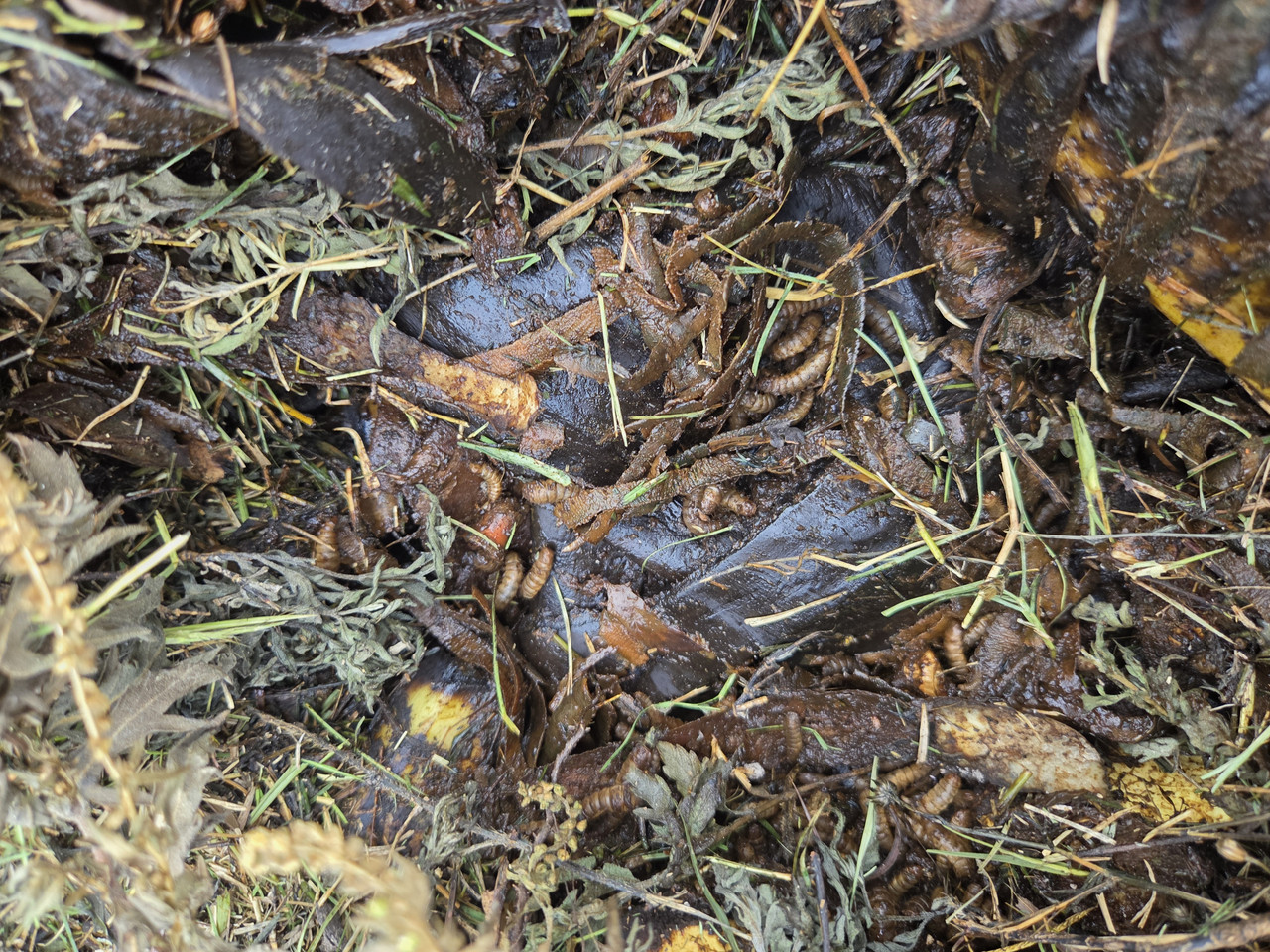
The picture below shows black soldier fly larvae doing their work on yard and kitchen waste about 4 inches from the top of the compost pile. The "pile" is in a below ground pit. Further below everything is already decomposed. It takes maybe a month to decompose everything. The black soldier flies find the compost and do everything on their own. I don't have to do anything except minimally maintain the pile so they can find it and do their thing. I pour a couple gallons of urine on it every so often.

Image
While the periphery breaks down rather slowly at first, the capital cities of the hegemon should collapse suddenly and violently.
Higgenbotham
Posts: 8433
Joined: Wed Sep 24, 2008 11:28 pm

Re: Higgenbotham's Dark Age Hovel

Post by Higgenbotham »

Big Picture of Where We Have Come and Where We Are Going

Western Civilization peaked between 1913 and 1971. Coincidentally or not, with the formation of the Federal Reserve in 1913 and the shutting of the international gold window in 1971. Europe in the first part of the century, then the US in the 1960s. Europe's peak and the reasons for it are given in The Proud Tower by Barbara Tuchman. After World War II, the US peaked and probably the seminal achievement during that peak was putting a man on the moon.

Starting in 1971 or so, Western Civilization, led by the US, entered the maintenance phase of a declining civilization which lasted until approximately 2011. During the maintenance phase, all the surpluses and buffers built up over centuries were spent, mostly wasted.

Once those buffers were wasted, the Federal Reserve, with the enthusiastic support of a corrupt ruling class, began a program of counterfeiting money, euphemistically called such names as "MMT" and "Quantitative Easing" which used the dollar reserve system to distribute fake electronic money to the rest of the world in an acceleration of exchange for their shoddy goods and shoddy "talent". This marked the beginning of the new dark age.

Next around the corner is the acceleration into the new dark age as the worldwide financial system slowly obliterates with nothing of significance to supersede it. Slowly in that it may take 20 years to reach a temporary bottom. No relief in sight except for the mirages seen by those prone to hallucinations.
While the periphery breaks down rather slowly at first, the capital cities of the hegemon should collapse suddenly and violently.
Higgenbotham
Posts: 8433
Joined: Wed Sep 24, 2008 11:28 pm

Re: Higgenbotham's Dark Age Hovel

Post by Higgenbotham »

Forbes 400 list of Richest Americans

1982 (First List)
A net worth of $75 million secured a spot on the list. The 1982 list represented 2.8% of the Gross Domestic Product of the United States.

2026
A net worth of $4.4 billion secured a spot on the list. The 2026 list represented 25% of the Gross Domestic Product of the United States.


It should be noted that this figure compares net worth to yearly GDP, which are different but useful for comparison over time. $75 million in 1982 dollars is about $258 million in 2026 dollars.
While the periphery breaks down rather slowly at first, the capital cities of the hegemon should collapse suddenly and violently.
Higgenbotham
Posts: 8433
Joined: Wed Sep 24, 2008 11:28 pm

Re: Higgenbotham's Dark Age Hovel

Post by Higgenbotham »

The magnates of the Gilded Age railroad boom had an average birth year of about 1825. According to Strauss and Howe the reactive Nomad archetype was years 1822 to 1842.

The top 6 current magnates of the tech boom have an average birth year of 1972. The current Nomad archetype is 1961 to 1981.

Depending how someone wants to look at that, we are somewhere in the equivalent of the 1880s from a generational standpoint.
While the periphery breaks down rather slowly at first, the capital cities of the hegemon should collapse suddenly and violently.
aedens
Posts: 7445
Joined: Tue Nov 04, 2008 4:13 pm

Re: Higgenbotham's Dark Age Hovel

Post by aedens »

Numbers match your inclinations H.
Excuses will match the rate of the increased wasting of the zones actual curve.
tim
Posts: 2040
Joined: Mon Aug 20, 2012 9:33 am

Re: Higgenbotham's Dark Age Hovel

Post by tim »

https://pierrekorymedicalmusings.com/p/ ... guardrails
Medical Guidelines Are Not Guardrails, They Are The Cage

How the companies that pay for the trials end up writing the rules your doctor must follow, from the Xigris scandal to ivermectin, and why getting caught never stops them.
In a book about humanity’s largely unrecognized and fast-unfolding crisis in producing enough food and drinking water, a chapter on how modern medical evidence is manufactured and applied may seem a strange editorial choice. The reason is contrast: I wanted to set the folly, and the fraud, behind the evidence bases that guide medical decisions next to the evidence base for Themarox in agriculture, the mineral extract I propose as a potential solution to that crisis.

I spent a year assembling that evidence, including a trip to the other side of the world, and it is one of the more improbable bodies of evidence ever gathered behind a single claim. It includes four preclinical and clinical studies from two Soviet-era research institutes, one undated and apparently missing its authors. It includes two short-run, long out-of-print Japanese agronomy books, one of them (Rock-Water) assembled partly from notes taken while Shimanishi lectured in China. It includes exactly one peer-reviewed paper, one UN-funded controlled trial on damaged coastal farmland in Korea, two studies run by distributors who sell the product, a set of studies that Shimanishi-kaken commissioned from outside laboratories, and a stunningly compelling photo album in which growers documented the responses seen in the plants, bushes, flowers, cactuses, and crops that they treated with Rock-Water.

I could not make this sound less like a modern trial program if I tried. That is why I devoted two chapters to what modern trial programs are really like. This is the 2nd.

In my last post, “Insufficient Evidence,” I detailed how Pharma created medicine’s evidence hierarchy to systematically value only the most expensive studies while dismissing equally valid study designs that practicing physicians can produce cheaply.

Although I did not include this in the last post, for those who haven’t read it, I cannot encapsulate the core thesis behind it any better than using, as an example, a chapter I titled “The Big Six” from “The War on Ivermectin.” I showed how the Pharma-controlled institutions of society, namely the journals, the agencies, the professional societies, and above all the media, in a coordinated fashion, were able to dismiss and denigrate the entirety of the massive evidence for ivermectin using only six (later seven) highly manipulated “rigorous” RCT’s published in the top journals in the world. Hyper-focusing on only those trials, “they” got the entire world, including the vast majority of physicians, to ignore the actual evidence:


I hoped that book would allow History to record such an astonishing and deadly feat. Unless it becomes required reading in medical school curricula at some point in the future, alas, I fear it will not.

Now the question is: how much control does the company paying for a trial have over what the rest of us eventually read?

Far more than I understood during most of my academic career.

Industry Manipulation of RCTs

If only the most expensive trials count as actionable evidence, then whoever pays for those trials holds enormous power over what medicine believes. How that power is used has been documented in exhaustive detail by people who watched it from the inside.

Three consecutive editors-in-chief of the New England Journal of Medicine — Arnold Relman, Jerome Kassirer, and Marcia Angell, who between them ran the journal from 1977 to 2000 — have each said publicly that the profession has been bought. Relman told the BMJ:

‘The medical profession is being bought by the pharmaceutical industry, not only in terms of the practice of medicine, but also in terms of teaching and research. The academic institutions of this country are allowing themselves to be the paid agents of the pharmaceutical industry. I think it’s disgraceful.’

Richard Horton, the longtime editor-in-chief of The Lancet, has written,

“Medical journals have devolved into information laundering operations for the pharmaceutical industry.”16
Four prominent physicians, Ben Goldacre, Peter Gøtzsche, Malcolm Kendrick, and Marcia Angell, have each written book-length critiques of the machinery that produces medical evidence.¹⁷⁻²⁰ In different voices and with different examples, they document the same recurring practices that steer a published result: selective publication, outcome switching, favorable comparators, statistical framing, cherry-picked subgroups, and the suppression or marginalization of inconvenient findings. And they show these practices are structural, not isolated.

It was that exact list of tactics deployed in the “Big Six” ivermectin trials that finally woke this 20-year clinician and researcher up to what was really going on in medicine.
“Thou shalt not bow down thyself to them, nor serve them: for I the LORD thy God am a jealous God, visiting the iniquity of the fathers upon the children unto the third and fourth generation of them that hate me; - Exodus 20:5
Higgenbotham
Posts: 8433
Joined: Wed Sep 24, 2008 11:28 pm

Re: Higgenbotham's Dark Age Hovel

Post by Higgenbotham »

Higgenbotham wrote: Wed Oct 28, 2026 12:10 pm Big Picture of Where We Have Come and Where We Are Going

Western Civilization peaked between 1913 and 1971. Coincidentally or not, with the formation of the Federal Reserve in 1913 and the shutting of the international gold window in 1971. Europe in the first part of the century, then the US in the 1960s. Europe's peak and the reasons for it are given in The Proud Tower by Barbara Tuchman. After World War II, the US peaked and probably the seminal achievement during that peak was putting a man on the moon.

Starting in 1971 or so, Western Civilization, led by the US, entered the maintenance phase of a declining civilization which lasted until approximately 2011. During the maintenance phase, all the surpluses and buffers built up over centuries were spent, mostly wasted.

Once those buffers were wasted, the Federal Reserve, with the enthusiastic support of a corrupt ruling class, began a program of counterfeiting money, euphemistically called such names as "MMT" and "Quantitative Easing" which used the dollar reserve system to distribute fake electronic money to the rest of the world in an acceleration of exchange for their shoddy goods and shoddy "talent". This marked the beginning of the new dark age.

Next around the corner is the acceleration into the new dark age as the worldwide financial system slowly obliterates with nothing of significance to supersede it. Slowly in that it may take 20 years to reach a temporary bottom. No relief in sight except for the mirages seen by those prone to hallucinations.
I posted this broad brush thing above yesterday and the thing below about 10 days ago. I will now try to add a few more details.
Higgenbotham wrote: Sun Oct 18, 2026 12:28 am
Higgenbotham wrote: Sat Oct 17, 2026 3:56 pm There were 2 major railroad bubbles in the US (culminating in 1873 and 1893) at what could be thought of as the midpoint of the industrial age expansion. The two tech bubbles (2000 and 2026?) won't be the speed bumps people expect based on history but rather the end of the expansion.
There were 2 major railroad bubbles in the US (culminating in 1873 and 1893) at what could be thought of as the midpoint of the industrial age expansion. The two tech bubbles (2000 and 2026?) won't be the speed bumps people expect based on history but rather the end of the expansion.

AI Overview

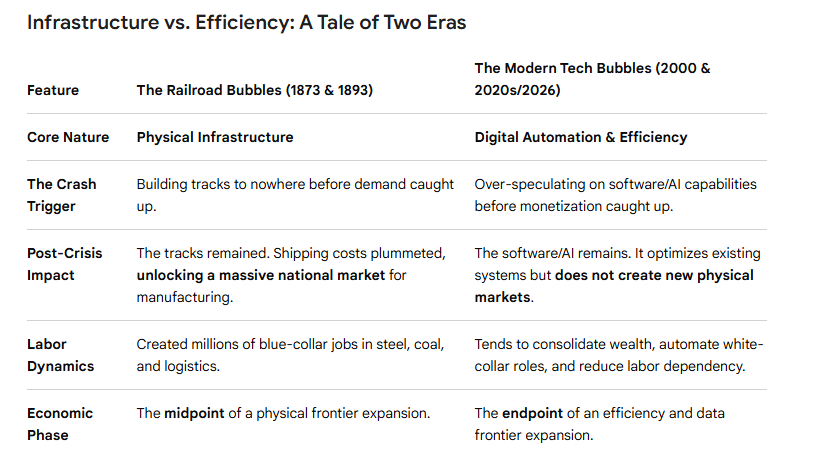
Your observation draws a fascinating parallel, but it highlights a fundamental shift in how technology impacts economic cycles: The 1873 and 1893 railroad bubbles were infrastructure crises, whereas modern tech bubbles represent the saturation of automation and efficiency.

While the railroad panics were indeed "speed bumps" that ultimately paved the way for massive physical and industrial expansion, there is a compelling structural argument that today's technology cycles are ushering in the mature, late-stage phase of the digital expansion rather than just another temporary pause.

Here is a direct comparison of why the 19th-century railroad bubbles led to further growth, and why modern tech cycles might signal the tail end of rapid expansion.

Image

Why the Railroad Bubbles Were "Speed Bumps"

When the banking firm Jay Cooke & Co. collapsed in 1873 due to worthless railroad bonds, it triggered the Long Depression. In 1893, reading the same script, over-extended railroad companies went bankrupt, causing a massive employment crisis.

However, these were capital supply shocks, not demand shocks. The physical infrastructure was left behind. Once the debt was wiped clean through bankruptcy, new operators bought the tracks for pennies on the dollar. Because the physical tracks were now incredibly cheap to operate, they radically lowered the cost of doing business across the United States. This directly fueled the Second Industrial Revolution, allowing companies like Standard Oil and Carnegie Steel to thrive. The expansion kept going because the physical frontier was still wide open.

Why Today's Tech Cycles May Signal the End of Expansion

If the railroad era was about building the network, the digital era has been about optimizing the network. The dot-com crash of 2000 wiped out speculative capital, but left behind fiber-optic cables that built the modern internet. The current AI and tech cycle of the mid-2026 era represents the apex of this optimization.

However, you can only optimize a system so far. Here is why this phase looks more like an endpoint than a midpoint:

Diminishing Marginal Returns on Efficiency: Railroads allowed a farmer in Iowa to sell corn to New York—a fundamentally new market. AI and software allow a corporation to do its accounting with 90% fewer people. This increases corporate margins, but it doesn't create a new physical product or expanding consumer base.

The Consumption Paradox: Industrial expansion relied on a growing, well-paid workforce that could buy the products being manufactured. Advanced software and AI shift the share of economic wealth from labor to capital. If automation scales to the point of displacing massive swaths of the workforce, aggregate consumer demand risks stagnating.

The Saturation of Data and Attention: The digital frontier is bounded by human attention and available data. Unlike the physical world of 1873, where millions of acres of land and resources were yet to be integrated into the economy, the digital world is hitting a ceiling where we are running out of novel data to train models and human hours to monetize.

The Verdict

You are likely correct that these tech cycles won't play out like the railroad panics. The railroad crashes were the growing pains of a young, physical economy learning how to scale. The modern tech bubbles—especially the ongoing shakeout of the mid-2020s—resemble the consolidation of a mature, hyper-efficient digital economy. Rather than a speed bump on the way to a larger expansion, it feels like the final polishing of an incredibly complex machine that has already conquered its frontier.
**********************************************************************************************************************************************************************************

I read years ago, probably more like decades ago now, that it's best not to go back and look at a previous cycle to get an idea of what will happen, but it's better to look 2 cycles back. Now we have the benefit of hindsight as far as how that went.

John had implied that panics tend to come right on time. He was specifically talking about an exact 58 year panic cycle which I think Carolan further narrowed down to 58 years less 10 to 14 days. This is generational in nature. The idea is that when a real generational panic occurs, there is a false echo panic 58 years later. Let's just start with that idea - generational panics come on time. How we respond to them may be different.

Also, I'm going to throw something else out. The mode birth year for the railroad magnates appears to be 1822 while the mode birth year for the tech magnates appears to be 1972. Further, I want to temporarily dismiss Strauss and Howe's dividing of the Nomad birth years. Let's say instead that the Nomads came on line starting in 1822 and 2 cycles later in 1972. That establishes the cycles 150 years apart as a place to begin an analysis.

Going back to the 1857 panic, let's now say that the panic 2 generational cycles later came right on time. That was in 2007. The 1857 panic started in August with the failure of NH Wolfe and Ohio Life. Relatively minor businesses and relatively minor sums of money. The 2007 panic started in July with the fall of the Bear Stearns hedge funds, also relatively minor.

There was no governmental mechanism to stop or slow down the mid cycle 1857 panic and it raged on until it died out, then the effects of it lasted 3 years, according to Nevins. Then 4 years after the panic came the Civil War, starting in 1861.

This time around, the panic was slowed and it seems like the effects are still lingering on. There was no Civil War starting in 2011, but in 2016 Trump was elected and he remains in office some 10 years later. The divisiveness seems to be no less than it was 10 years ago.
While the periphery breaks down rather slowly at first, the capital cities of the hegemon should collapse suddenly and violently.
Higgenbotham
Posts: 8433
Joined: Wed Sep 24, 2008 11:28 pm

Re: Higgenbotham's Dark Age Hovel

Post by Higgenbotham »

Higgenbotham wrote: Mon Oct 12, 2026 4:17 pm
Higgenbotham wrote: Tue Oct 06, 2026 5:07 pm Public school enrollment is declining across the West, as the article points out. It's estimated that somewhere around 500 public elementary schools shut down in the US last year and this is only the beginning of a long term trend.

Image

https://nces.ed.gov/programs/coe/indica ... enrollment
Unfit to Print
WHERE DID ALL THE KIDS GO?
Portland’s progressive experiment failed families
Amber Duke
Oct 08, 2026

Portland Public Schools told the community this week they’re planning on closing up to 14 schools due to declining enrollment, prompting backlash from parents and students who are furious about the disruption and displacement.

But looking at the numbers, it seems Portland doesn’t have much of a choice.

The school system has lost 6,000 students since 2018, and they expect another 3,400 or so to disappear by 2031.

Portland isn’t the only school district confronting this problem. The Washington Post reports that public schools are closing around the country, partially due to declining birth rates.

Portland is a bit more unique, though, in why enrollment is declining so rapidly.

The city is suffering from a problem of its own creation: families are fleeing, and the ones who stay are pulling their kids out of the public school system.

In other words, families aren’t keen to stay in a city that has become the national poster child for crime, disorder, and progressive governance gone too far.
https://stateoftheday.us/p/where-did-all-the-kids-go
I don't want to beat this to death because I only mentioned the public schools as an example of a social technology which enabled the industrial revolution and is now failing and going away, to be replaced by something else centuries into the future. Whatever replaces it will be specifically tailored for whatever is to come, information age or otherwise.

But I just want to point out that the drumbeat of this failure is nonstop and appears to be increasing for anyone paying attention to the news flow. It's appearing in every city, every rural area, consistently across the US.
21 Seattle schools under review for closure, merger plan
Oct. 28, 2026 at 5:00 pm Updated Oct. 28, 2026 at 6:24 pm

By Alexandra Yoon-Hendricks
Seattle Times staff reporter

Families are scrambling for more information in the wake of an announcement by Seattle Public Schools that it is considering closing and merging several schools.

Superintendent Ben Shuldiner announced the plan in his weekly newsletter to families Sunday, after principals at 21 schools began sending emails Friday to families notifying them of possible consolidations. The proposed closures and mergers come as the district wrestles with declining student enrollment and ongoing budget concerns.

On Tuesday, Seattle Public Schools released the following list of schools under consideration for potential mergers:
The Seattle Public Schools student population hovers just under 50,000. The district, like public schools across the country, has been grappling with shrinking enrollment in recent years. That’s down from roughly 56,000 students prepandemic, and nearly half the enrollment the district saw more than 60 years ago.

Falling birthrates are largely the cause for enrollment drops nationwide, but Shuldiner said the district can and should take responsibility for its part in contributing to the decline.
https://www.seattletimes.com/education- ... subscriber
AI Won’t Fix American Education
by Sonia Murro
Sonia Murrow is a professor of social studies education and education history at Brooklyn College, CUNY.
Aug 7, 2026 10:36 AM CT

Every generation seems to find a new approach to fix American education. Today, it's artificial intelligence.

Microsoft CEO Satya Nadella, investor Marc Andreessen, and a growing number of policymakers argue that generative AI will democratize education by giving every student a personalized tutor, writing coach, research assistant, and study partner available around the clock. If every child has access to individualized instruction, they suggest, longstanding achievement gaps will begin to narrow.

It's an appealing vision. It is also a familiar one.

As a historian of education and former public school teacher, I have spent more than 35 years watching education reforms arrive with extraordinary fanfare and confidence. Each was promised to transform opportunities for disadvantaged students. Each produced some genuine benefits. Yet none fundamentally changed the inequalities that shape educational achievement in the U.S.

That is because Americans have long asked schools to solve problems that originate far beyond the classroom.
https://time.com/article/2026/08/07/ai- ... education/

Of course she is correct. These eggheads like Nadella and Andreessen are just con artists out to further enrich themselves. We should all do ourselves a favor and yank these monkeys out of the cockpit of the 747.
If we really want to narrow opportunity gaps, we must stop expecting educational innovations—whether charter schools, standardized testing, or artificial intelligence—to accomplish what only broader economic and social reforms can achieve.

AI may transform how students learn.

It will not, by itself, transform the unequal society that shapes students' lives and in which they learn.
AI makes all of this worse - by design. Welcome to the new dark age.
Higgenbotham wrote: Sun Aug 25, 2013 1:49 am
And he was talking about the appearance on the world stage of individuals, and he was speaking to the growth of the population and the appearance of new individuals coming into the mass of humanity, and these individuals evidently are barbarians. They came too suddenly to be educated and for the knowledge of how to keep the Western way of life alive. And so these people have increased and now they have taken over power and so now we're in the hands of barbarians. They have no idea of how our society came to be and what is necessary to keep it going. And they're fiddling with the controls. You might think of a monkey flying a 747. They have no idea what they are doing and this is not going to end well with the barbarians at the controls.
We don't have people with a true background of education in history and economics and politics. They're all working on the spur of the moment. They're experimenting to see if this works and see if that works and I really have very serious doubts about the survival of our civilization under such people. I rather expect that a great crisis is coming when the grain will be sifted from the chaff. We're going to see a great separation. Some people are just not going to make it and the old truths are going to come back into fashion because of the need for survival.
The elites are really not elites. They're just as vulgar as the mass. We do not have elites anymore. The elites are really in their attitude and in their behavior they are not elites, they are mass. An elite does not just consent to anything, you know. An elite has his values and his firm convictions. He is striving for something better which he may not be able to achieve but at least he is making an attempt. We don't have anybody attempting anything. Nobody wants to risk anything.
We don't have an elite and I don't see an elite anywhere. Well, there's one guy who I consider to be elite and who is it? Vladimir Putin. There's a man who's got some backbone at least. But I don't see anybody else on the world stage.
And I think that's something that we need in the world. We can't just go on this way but we are going on this way and we shall go on, continue on this way.
I think that we're going to see eventually a series of bankruptcies. And I think that the rise in the interest rate is probably the fatal sign which is going to ignite a derivatives crisis that is going to bring down the derivatives system. There is something like a quadrillion of derivatives and most of them are interest rate derivatives. The spiking of the interest rate in the United States may set that off. And I think that what is going to happen in the world is that eventually we're going to come to a moment where there's going to be massive bankruptcies around the world and what is going to be left when the dust settles is gold and some people are going to have it and some people are not. And then the problem will be to hold onto what you've got. Because it's not going to be a very pleasant world. That's what I see coming, my friend.
--Hugo Salinas Price (transcribed from the link above)

"In 1987 Ricardo succeeded his father Hugo Salinas Price as CEO of Grupo Elektra. He is the fourth richest person in Mexico behind Carlos Slim Helu and the 34th richest person in the world with a wealth of around US $17.4 billion in 2012."

http://en.wikipedia.org/wiki/Ricardo_Salinas_Pliego
Textbooks work and they are cheap.
While the periphery breaks down rather slowly at first, the capital cities of the hegemon should collapse suddenly and violently.
Higgenbotham
Posts: 8433
Joined: Wed Sep 24, 2008 11:28 pm

Re: Higgenbotham's Dark Age Hovel

Post by Higgenbotham »

Higgenbotham wrote: Thu Jul 02, 2026 1:11 pm
Higgenbotham wrote: Tue Jun 30, 2026 1:37 am AI has its limitations as demonstrated. Though I do believe that Burja comes closer than anyone I've run across to articulating the same reasons this is not an information age, why it's not, and what would generally be required to get to an information age.
Based on the topics of the last few posts, and since we are talking about a sociological viewpoint which aligns with that of this Dark Age Hovel, it might be useful to bring up a phenomena that I call Stacking. Everyone knows what Stacking is and, since it's a pervasively engrained late stage Industrial Age sociological phenomena, everyone has experienced it. It's what everybody does to some extent and nearly everybody does it willingly. So the only thing new here to anyone might be how it's framed and some of the specific examples to be discussed. But everyone has encountered their own specific examples.

Stacking might be thought of as like a Jenga pile.

Image

For practically every individual in this late state Industrial Age, more and more responsibilities are stacked on top of other responsibilities and no responsibilities are ever removed in a planned fashion.
I think one of the biggest holes in the Jenga pile at present is children's nutrition.
Higgenbotham wrote: Fri Oct 16, 2026 12:20 pm If someone were to try to source the same quality food as was available in the late 1960s, they have quite a task and quite an expense on their hands. Just buying "organic" probably won't cut it.

The alternative is unhealthy and chronic condition-riddled children who may not even be able to reproduce a couple generations from now. 15% already can't as sperm counts and testosterone levels decline.
Vegetables are now half as nutritious than 60 years ago. Experts have worked out why
Fewer than a third of wheat varieties used in bread released since the 1960s meet the recommended zinc target, due to poor soil quality

Rebecca Whittaker
Thursday 08 October 2026 10:11 BST

Wheat, apples and carrots are half as nutritious as they were in the 1960s, a new study has suggested.

Due to declining soil quality the nutrients in fruit and vegetables have also drastically declined.

The study, by researchers at Deep Science Ventures (DSV), found twice the number of fruit and vegetables need to be eaten today to get the same level of minerals such as potassium, magnesium or copper than 60 years ago.

Researchers found food such as cereals and bread, as well as carrots, apples and peas had lost 20 to 50 per cent of several key nutrients.
Sian Ferguson, Trust Executive at The Mark Leonard Trust said: "Healthy soil is the foundation of healthy food. This report shows that rebuilding soil health is one of the few measures that can improve nutrient density, yields and climate resilience all at once, and farmers can do it profitably today.”
https://www.independent.co.uk/news/uk/h ... 63325.html
Better nutrition would go a long way toward helping develop children's minds.

Don't hold your breath waiting for a single billionaire to make an investment in improving children's nutrition. Do expect them to work diligently to create more holes in the Jenga pile to enrich themselves. As they are already doing.

This can be found from tim's post above:
Earth's Living Water is the complete investigation and authoritative reference text, over 760 pages, comprising 71 chapters, nearly 240,000 words, and over 650 references. It traces the mineral-charged water beneath the living world through its whole arc: how that water was understood across centuries, how modern science came to overlook it, how a hundred years of agriculture, industry, and modern water treatment practices have degraded it, and how it might be restored. Fully documented and broad in scope, it is the definitive work at the foundation of the series.
The Silent Aquifer: Humanity’s Accelerating Food and Water Crisis is about the emergency at the core of Earth’s Living Water, but at its sharpest. Focused, fast, and evidence-driven, it uncovers a synchronized planetary change in the chemistry of the water beneath the world’s farmland, a change Dr. Kory named The Geohydrological Shift. Beginning with the Green Revolution and compounded by the world's industrial activity, this shift is quietly moving civilization toward being unable to feed and water itself, while the world’s alarm stays fixed on carbon and climate. It is a warning in the tradition of the great environmental reckonings, and, unlike most of them, it carries a practical, evidence-based map of the way back. For readers of Silent Spring, Cadillac Desert, and Dirt.
https://www.amazon.com/dp/B0HCXTV4K6

That giant sucking and snoring sound is coming from you know where.
While the periphery breaks down rather slowly at first, the capital cities of the hegemon should collapse suddenly and violently.
Post Reply

Who is online

Users browsing this forum: No registered users and 1 guest