Higgenbotham's Dark Age Hovel

tim
Posts: 1600
Joined: Mon Aug 20, 2012 9:33 am

Re: Higgenbotham's Dark Age Hovel

Post by tim »

https://rooktoking.substack.com/p/goldu ... e-past-the
Gold/USD vs Weimar: Are We Past the Point of No Return?
As gold and silver continue their steep climb, many precious metals investors no doubt are thinking about what their profit targets are, and when they might exit their positions in this current precious metals bull market cycle and rotate back into stocks and other investments after the crash of the Everything Bubble brings equities and real estate prices back to earth.

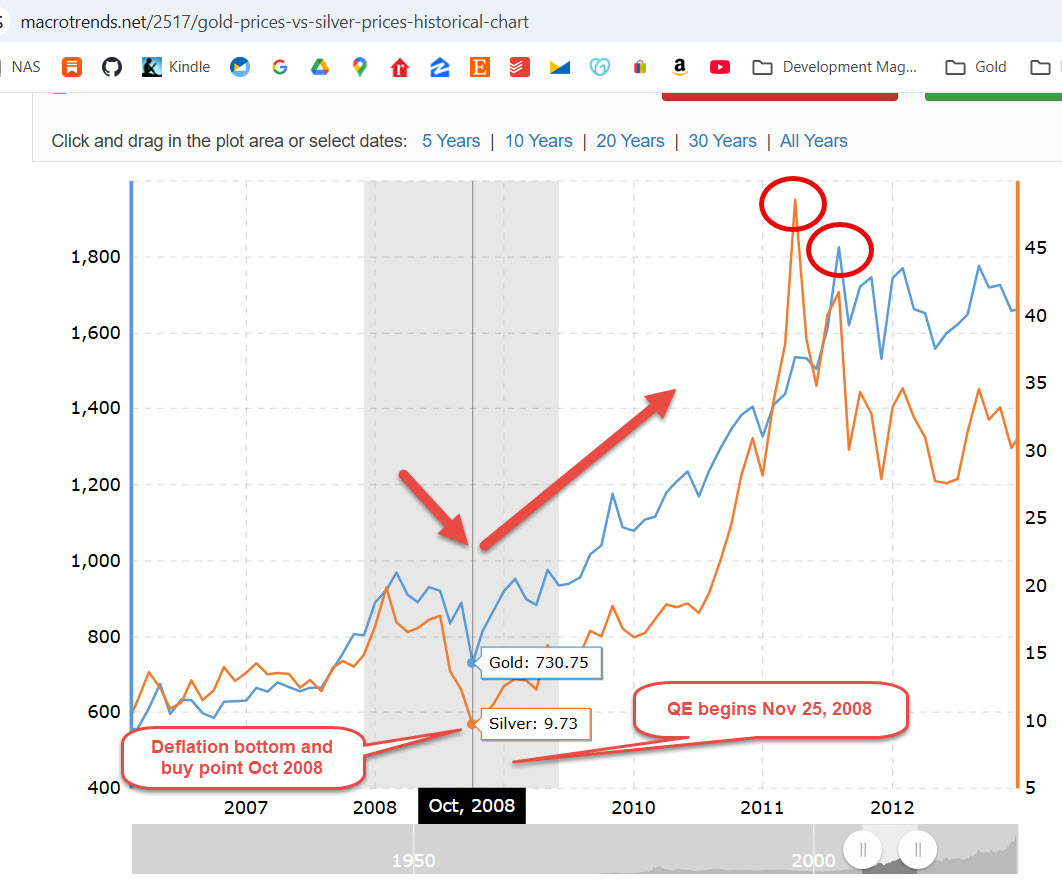
Using the last 2007-2009 recession as an example, silver topped first in 2011 followed by gold:

Image

I was planning on using this same playbook for the next upcoming (imminent) recession that will surely precipitate bazooka QE followed by a spectacular run in gold & silver, and then look for signs of a top to sell my gold and silver (and miners) to finance rental property investments when real estate prices bottom out.

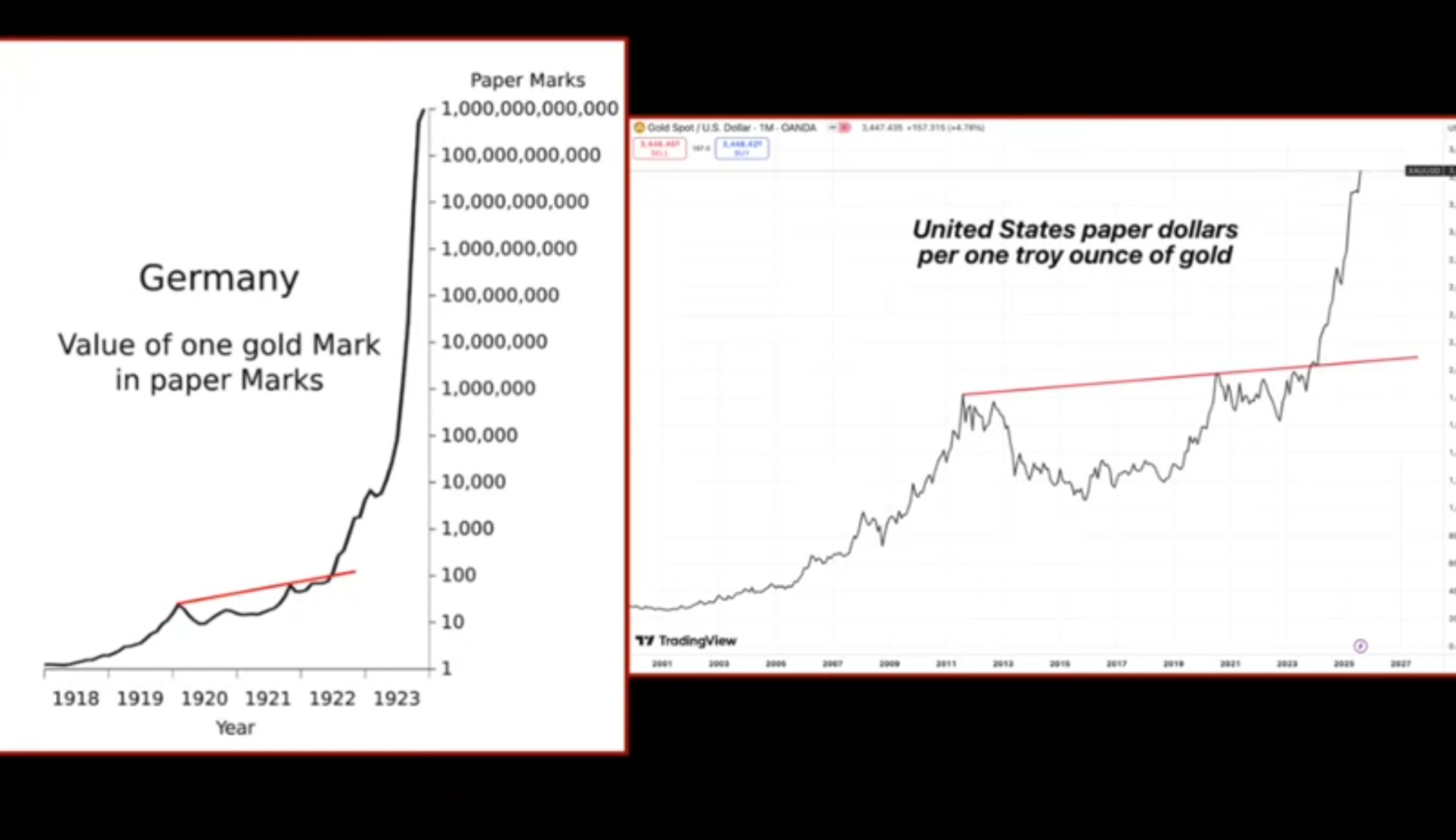
That was the plan… until I saw this comparison of two side-by-side charts below (from The Pareto Investor). This particular coupling of charts caught my eye, and has been nagging at me ever since.

Image

I was intrigued by these side-by-side charts, in particular the neckline the author had drawn across the cup & handle pattern in both, which in my opinion clearly highlights the striking similarity between them.

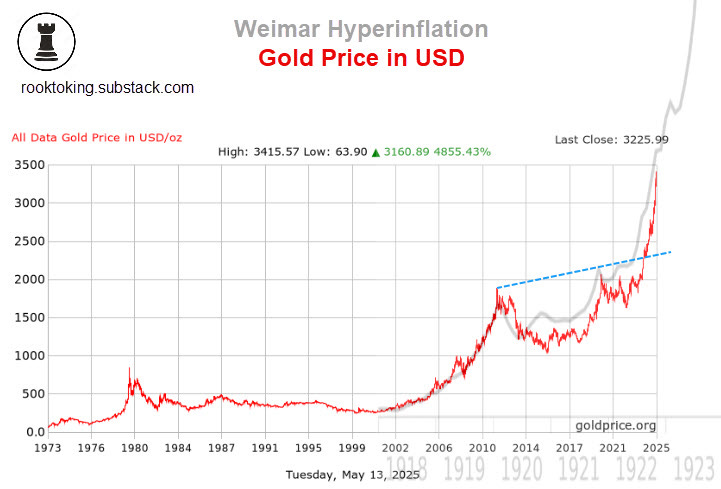
Just for kicks, because I wanted to more closely examine the similarity between these two charts, I copied and superimposed the Weimar chart on top of a chart from goldprice.org, combining the two as shown below to obtain a more direct visual comparison:

Image

Of course, this is not going to be an apples to apples comparison, as the time frame of the Weimar hyperinflation from 1918-1923 was very compressed compared to what is occurring right now with gold priced in USD. So when I copied the Weimar chart and overlayed it, I had to stretch the X and Y axis a bit to try and obtain the best fit to the Gold/USD chart.

However, I was truly astonished at how closely the initial curved run-up in price to the cup & handle patterns matched (almost identically), and how the peaks of the left and right edge of the cup lined up. The points of confirmation of the neckline breakouts from the cup & handle patterns differed slightly, but after the breakout we all know what happened next in Weimar…

So the question then becomes, are we past the point of no return in Gold/USD? Are we really on the verge of hyperinflation here in the United States? How could it be possible that this could happen to the most powerful country in the world, and so quickly? I had always thought hyperinflation might occur here, but that it was sometime far off in the distant future.

Doing a quick Photoshop comparison by superimposing charts is certainly not a rigorous scientific, mathematical or statistical comparison of Weimar gold prices to today’s gold in USD. However, the similarities between the two charts are clearly apparent upon visual inspection, and I am beginning to wonder if we are reaching the terminal phase for the USD as the pattern above would indicate. Perhaps this time I might rethink my plan for short-term profit taking to finance other investments, and that instead I might hold onto my gold and silver for dear life until the conclusion of this monetary reset we have all been told is coming…whatever that may look like.

. . .

Last weekend I watched a movie called A Night to Remember (1958) about the sinking of the RMS Titanic in 1912. I recommend that all of you watch that movie, not because it has anything to do with investments, but because it is analogous to the situation in which we find ourselves today.

Many financial analysts have drawn comparisons between the anticipated upcoming crash of the Everything Bubble to the Titanic striking an iceberg. In particular, Henrik Zeberg, who is a brilliant technical analyst, has stated that his models indicate we have already hit the iceberg, and it is only a matter of time before we enter recession or worse.

What struck me about this RMS Titanic movie is the portrayal of the psychology of the passengers, even after hitting the iceberg, clinging to their belief that the Titanic was unsinkable. I can remember communicating my worries several years ago about potential hyperinflation to relatives who responded with looks that clearly said “Don’t be ridiculous, that could never happen here!”

Yet here we are, with the Weimar vs Gold/USD chart shown above, and the still shot from the movie showing Thomas Andrews, the architect of the RMS Titanic — examining the damage from the iceberg and explaining to Captain Edward John Smith that the Titanic is going to sink. After coming to terms with the harsh reality of the situation, the captain then orders the lifeboats be swung out and prepared for the women and children.

As I watched the movie, and the final terrifying plunge of the Titanic into the freezing abyss with 1500 people still aboard who tragically lost their lives, I thought about the impending financial crisis and destruction of wealth that is occurring in the form of currency debasement “first slowly, then suddenly all at once”. And my attention then turned to the Weimar chart above, and to the warnings issued by many others who have stated that gold (and silver) are the lifeboats that will save those and their families who had the foresight to recognize this impending global debt catastrophe.

I am very interested to know what other people’s thoughts are regarding where we are on the hyperinflation curve, and whether you believe that we have a couple cycles of ups and downs left to buy and sell… or if you are convinced that we are beyond the point of no return, and that this gold run will only go vertical from here. Please do share your thoughts in the comments below.
“Thou shalt not bow down thyself to them, nor serve them: for I the LORD thy God am a jealous God, visiting the iniquity of the fathers upon the children unto the third and fourth generation of them that hate me; - Exodus 20:5
tim
Posts: 1600
Joined: Mon Aug 20, 2012 9:33 am

Re: Higgenbotham's Dark Age Hovel

Post by tim »

https://www.compactmag.com/article/the-lost-generation/
The Lost Generation

Jacob Savage
This was it, the moment our careers were supposed to take off. We’d put in our time—I’d been tutoring SATs and reselling tickets to make ends meet while I wrote—and five years seemed par for the course, based on the slightly older guys we knew who’d made it.

But of course, by 2016, we were already too late.

The showrunner emailed us back apologetically. “I had initially thought I might be able to bring you guys on,” he wrote, “but in the end it wasn’t possible.”

We met with the executive anyway—a Gen-X white guy—who told us how much he loved our pilot. But the writers room was small, he explained apologetically, and the higher-level writers were all white men. They couldn’t have an all-white-male room. Maybe, if the show got another season, they’d be able to bring us on.

They never did.

The doors seemed to close everywhere and all at once. In 2011, the year I moved to Los Angeles, white men were 48 percent of lower-level TV writers; by 2024, they accounted for just 11.9 percent. The Atlantic’s editorial staff went from 53 percent male and 89 percent white in 2013 to 36 percent male and 66 percent white in 2024. White men fell from 39 percent of tenure-track positions in the humanities at Harvard in 2014 to 18 percent in 2023.

In retrospect, 2014 was the hinge, the year DEI became institutionalized across American life.

In industry after industry, gatekeepers promised extra consideration to anyone who wasn’t a white man—and then provided just that. “With every announcement of promotions, there was a desire to put extra emphasis on gender [or race],” a former management consultant recalled. “And when you don’t fall into those groups, that message gets louder and louder, and gains more and more emphasis. On the one hand, you want to celebrate people who have been at a disadvantage. On the other hand, you look and you say, wow, the world is not rooting for you—in fact, it’s deliberately rooting against you.”
This isn’t a story about all white men. It’s a story about white male millennials in professional America, about those who stayed, and who (mostly) stayed quiet. The same identity, a decade apart, meant entirely different professional fates. If you were forty in 2014—born in 1974, beginning your career in the late-90s—you were already established. If you were thirty in 2014, you hit the wall.

Because the mandates to diversify didn’t fall on older white men, who in many cases still wield enormous power: They landed on us.
These weren’t empty slogans, either. In 2021, new hires at Condé Nast were just 25 percent male and 49 percent white; at the California Times, parent company of The Los Angeles Times and The San Diego Union-Tribune, they were just 39 percent male and 31 percent white. That year ProPublica hired 66 percent women and 58 percent people of color; at NPR, 78 percent of new hires were people of color.

“For a typical job we’d get a couple hundred applications, probably at least 80 from white guys,” the hiring editor recalled. “It was a given that we weren’t gonna hire the best person… It was jarring how we would talk about excluding white guys.” The pipeline hadn’t changed much—white men were still nearly half the applicants—but they were now filling closer to 10 percent of open positions.

Suddenly, in Andrew’s newsroom, everything was driven by identity. There were endless diversity trainings, a racial “climate” assessment—at one point, reporters were told they had to catalog, in minute detail, the identity characteristics of all their sources. Andrew had been instrumental in forming the union at his company, and objected when negotiations shifted from severance pay and parental leave to demands for racial quotas. “They wanted to do like ... emergency hires of black people,” he said.
With or without quotas, The Atlantic succeeded in hiring fewer of these white males. Since 2020, nearly two-thirds of The Atlantic's hires have been women, along with nearly 50 percent people of color. In 2024, The Atlantic announced that three-quarters of editorial hires in the past year had been women and 69 percent people of color.

The irony was, where older white men remained in charge, especially where they remained in charge, there was almost no room to move up. “If you hired a team of white guys around you, you were putting a target on your back,” recalled the hiring editor. At The New York Times Magazine (one of the few prestige magazines with a public masthead), Jake Silverstein, a Gen-X white man, serves as editor-in-chief, and Bill Wasik, another Gen-X white man, serves as editorial director. But of nine millennial senior editors and story editors below them, there’s just one white guy—and he’s been there since 2012, effectively grandfathered in.

At the very bottom of the ladder, the picture is little different. Since 2020, only 7.7 percent of Los Angeles Times interns have been white men. Between 2018 and 2024, of the roughly 30 summer interns each year at The Washington Post, just two or three were white men (in 2025, coincident with certain political shifts, the Post’s intern class had seven white guys—numbers not seen since way back in 2014). In 2018 The New York Times replaced its summer internship with a year-long fellowship. Just 10 percent of the nearly 220 fellows have been white men.

Other pipelines dried up as well. The alt-weeklies that gave misfit young men their start have shed them entirely. There are no white men on the editorial staff of the Seattle Stranger or on the staff of Indy Week. As late as 2017, there were six white men atop the masthead for the Portland Mercury. By 2024, there was just one: the Boomer editor-in-chief.

By the early 2020s, many journalists I spoke to noticed something else: The young white men who once flooded internship and fellowship pools had simply stopped applying. Gen-Z men had absorbed the message that journalism was not for them.

“The femaleness is striking,” a well-known Gen-X reporter with impeccable liberal bona fides confided. “It’s like, wow, where have the guys gone?”

In less than a decade, the entire face of the industry changed. The New York Times newsroom has gone from 57 percent male and 78 percent white in 2015 to 46 percent male and 66 percent white in 2024. Condé Nast today is just 35 percent male and 60 percent white. BuzzFeed, a media operation that had been 52 percent male and 75 percent white in 2014, was just 36 percent male and 52 percent white by 2023.

But nothing explains the New Media story quite like Vox, whose explainers dominated 2010s discourse and whose internal demographics capture the decade’s professional shift. Back in 2013, when Ezra Klein came under fire for his start-up’s lack of diversity, Vox Media was 82 percent male and 88 percent white. By 2022 the company was just 37 percent male and 59 percent white, and by 2025 leadership was 73 percent female.

The demographic shift reshaped not only who told the stories, but which stories got told. After George Floyd’s death, Andrew’s colleague Lucas was assigned a piece about why you should never call the police. “I remember having to interview one of these abolitionists for a story about how if somebody breaks into your car or your home, it’s white supremacy to call the cops—even if you need it for an insurance report,” Lucas told me. “That always made me feel gross. I think back on that with a lot of regret.”
“Thou shalt not bow down thyself to them, nor serve them: for I the LORD thy God am a jealous God, visiting the iniquity of the fathers upon the children unto the third and fourth generation of them that hate me; - Exodus 20:5
tim
Posts: 1600
Joined: Mon Aug 20, 2012 9:33 am

Re: Higgenbotham's Dark Age Hovel

Post by tim »

https://www.youtube.com/watch?v=pruKbaVdPkA
Most thought the housing bubble was just rent subsidies.

Wrong.
The FHA was selling homes to illegals, using taxpayer-backed mortgages.

“I thought they were just supporting prices via the rental market… but they were actually buying homes.”

Now the market’s cracking.
Prices falling.
Layoffs rising.
Wages flat.
Americans can’t afford to buy.

“We need a sharp correction. Not 50-year mortgages to paper it over.”

And the Trump administration?
“They think they can talk their way through this. They can’t. Claiming a ‘golden age’ is backfiring.”

Ed Dowd says unless they’re honest: about what they inherited, what’s coming, and what it’ll take to fix it, they might lose the midterms.

This isn’t theory.
It’s data. It’s real.
And no one in D.C. wants to admit it.
“Thou shalt not bow down thyself to them, nor serve them: for I the LORD thy God am a jealous God, visiting the iniquity of the fathers upon the children unto the third and fourth generation of them that hate me; - Exodus 20:5
Post Reply

Who is online

Users browsing this forum: No registered users and 2 guests