by Higgenbotham » Tue Oct 06, 2026 5:07 pm
Higgenbotham wrote: Thu Sep 10, 2026 11:28 pm
As the public school system degrades, the industrial production process will degrade. People will home school. People will send their kids to a variety of private schools that prepare kids for a variety of things. People will pull their kids out of schools and do nothing. Public schools will shut down in some areas. Where public schools shut down in some areas, maybe some of those people will move so they can continue to send their kids to public school and maybe some won't. But none of that is suddenly going to produce information-age-ready 18 year olds. The industrial production system is going to continue to degrade, collapse, hit bottom, not entirely going away, and then something, some spark, some series of sparks over decades and centuries will create a new set of social technologies specifically tailored for the new information age or whatever it is that is going to come.
On a remote Greek island, empty classrooms signal a crisis across Europe
By LEFTERIS PITARAKIS and DEREK GATOPOULOS
Updated 1:30 AM CDT, October 5, 2026
Leer en español
Comments 28
KALAMOS, Greece (AP) — Chryssa Ntalaka’s classroom has become an object lesson in subtraction.
The sole teacher in the last school on the idyllic Greek island of Kalamos has a shorter list of students every fall. This year, just two. On Sept. 23, the sixth graders sat at Ntalaka’s table beneath the whiteboard, in front of rows of unused desks and benches.
When they head to middle school on Greece’s mainland next year, her school will be mothballed. Toys and picture books still sit on shelves in the nearby kindergarten since it was shuttered three years ago.
“Usually, teachers are placed on these islands against their wishes,” Ntalaka told The Associated Press. “Whereas for Kalamos there are teachers and kindergarten teachers, as far as I know, who want to come — but there are no children.”
Falling enrollment across Greece this year prompted authorities to close 75 schools and suspend or extend suspension of classes at more than 400 others.
It’s a situation playing out across Europe and beyond. The region has 16 of the world’s top 20 oldest nations, particularly in Southern Europe, according to the independent World Population Review.
And its remote communities act as an early warning system: Mountain villages and small islands are among the first places where schools and services disappear in a deepening cycle of population decline. Some 17 million people live on more than 4,000 islands across the European Union; Greece has about 200 of them.
“Closing schools leads to young people not staying and to them leaving,” said Byron Kotzamanis, co-founder of the Institute of Demographic Research in Athens. “Leaving means fewer and fewer people — fewer and fewer births. It means depopulation and dead settlements that will become nursing homes.”
https://apnews.com/article/greece-europ ... wtab-en-us
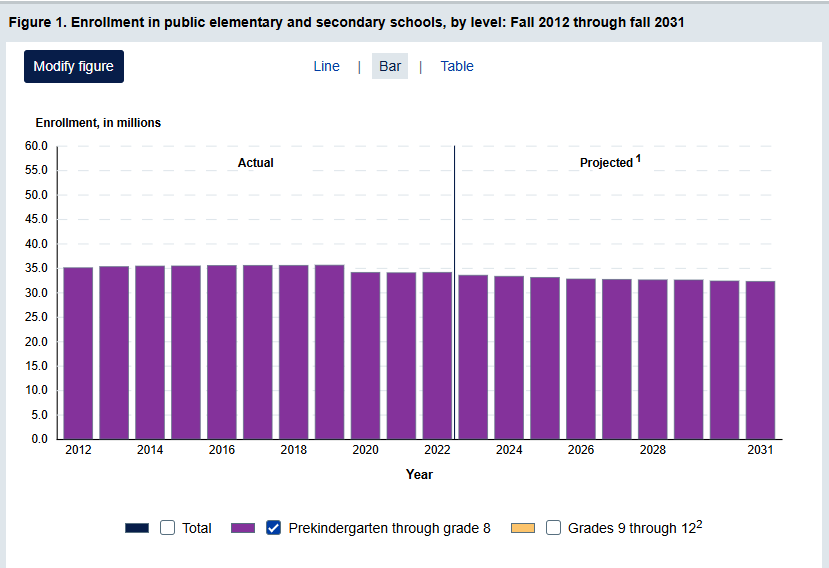
In the comments section of the AP article, people have shown their stupidity and ignorance by barking about everything except the most salient fact on the ground. Public school enrollment is declining across the West, as the article points out. It's estimated that somewhere around 500 public elementary schools shut down in the US last year and this is only the beginning of a long term trend.
 https://nces.ed.gov/programs/coe/indica ... enrollment
[quote=Higgenbotham post_id=95395 time=1789097286 user_id=100]
As the public school system degrades, the industrial production process will degrade. People will home school. People will send their kids to a variety of private schools that prepare kids for a variety of things. People will pull their kids out of schools and do nothing. Public schools will shut down in some areas. Where public schools shut down in some areas, maybe some of those people will move so they can continue to send their kids to public school and maybe some won't. But none of that is suddenly going to produce information-age-ready 18 year olds. The industrial production system is going to continue to degrade, collapse, hit bottom, not entirely going away, and then something, some spark, some series of sparks over decades and centuries will create a new set of social technologies specifically tailored for the new information age or whatever it is that is going to come.[/quote]
[quote]On a remote Greek island, empty classrooms signal a crisis across Europe
By LEFTERIS PITARAKIS and DEREK GATOPOULOS
Updated 1:30 AM CDT, October 5, 2026
Leer en español
Comments 28
KALAMOS, Greece (AP) — Chryssa Ntalaka’s classroom has become an object lesson in subtraction.
The sole teacher in the last school on the idyllic Greek island of Kalamos has a shorter list of students every fall. This year, just two. On Sept. 23, the sixth graders sat at Ntalaka’s table beneath the whiteboard, in front of rows of unused desks and benches.
When they head to middle school on Greece’s mainland next year, her school will be mothballed. Toys and picture books still sit on shelves in the nearby kindergarten since it was shuttered three years ago.
“Usually, teachers are placed on these islands against their wishes,” Ntalaka told The Associated Press. “Whereas for Kalamos there are teachers and kindergarten teachers, as far as I know, who want to come — but there are no children.”
Falling enrollment across Greece this year prompted authorities to close 75 schools and suspend or extend suspension of classes at more than 400 others.
It’s a situation playing out across Europe and beyond. The region has 16 of the world’s top 20 oldest nations, particularly in Southern Europe, according to the independent World Population Review.
And its remote communities act as an early warning system: Mountain villages and small islands are among the first places where schools and services disappear in a deepening cycle of population decline. Some 17 million people live on more than 4,000 islands across the European Union; Greece has about 200 of them.
“Closing schools leads to young people not staying and to them leaving,” said Byron Kotzamanis, co-founder of the Institute of Demographic Research in Athens. “Leaving means fewer and fewer people — fewer and fewer births. It means depopulation and dead settlements that will become nursing homes.”[/quote]
https://apnews.com/article/greece-europe-islands-eemographics-decline-74ab56fd7ad3943b6aabd5f0918ef654?utm_source=firefox-newtab-en-us
In the comments section of the AP article, people have shown their stupidity and ignorance by barking about everything except the most salient fact on the ground. Public school enrollment is declining across the West, as the article points out. It's estimated that somewhere around 500 public elementary schools shut down in the US last year and this is only the beginning of a long term trend.
[img]https://i.postimg.cc/85jrcJH3/Screenshot-2026-10-06-163110.png[/img]
https://nces.ed.gov/programs/coe/indicator/cga/public-school-enrollment