by Higgenbotham » Thu Oct 29, 2026 12:15 pm
Higgenbotham wrote: Mon Oct 12, 2026 4:17 pm
Higgenbotham wrote: Tue Oct 06, 2026 5:07 pm
Public school enrollment is declining across the West, as the article points out. It's estimated that somewhere around 500 public elementary schools shut down in the US last year and this is only the beginning of a long term trend.
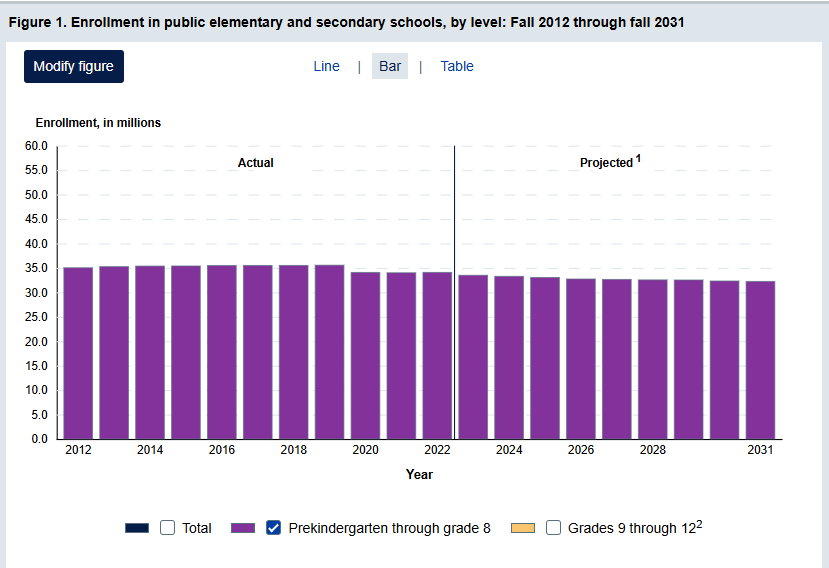 https://nces.ed.gov/programs/coe/indica ... enrollment
Unfit to Print
WHERE DID ALL THE KIDS GO?
Portland’s progressive experiment failed families
Amber Duke
Oct 08, 2026
Portland Public Schools told the community this week they’re planning on closing up to 14 schools due to declining enrollment, prompting backlash from parents and students who are furious about the disruption and displacement.
But looking at the numbers, it seems Portland doesn’t have much of a choice.
The school system has lost 6,000 students since 2018, and they expect another 3,400 or so to disappear by 2031.
Portland isn’t the only school district confronting this problem. The Washington Post reports that public schools are closing around the country, partially due to declining birth rates.
Portland is a bit more unique, though, in why enrollment is declining so rapidly.
The city is suffering from a problem of its own creation: families are fleeing, and the ones who stay are pulling their kids out of the public school system.
In other words, families aren’t keen to stay in a city that has become the national poster child for crime, disorder, and progressive governance gone too far.
https://stateoftheday.us/p/where-did-all-the-kids-go
I don't want to beat this to death because I only mentioned the public schools as an example of a social technology which enabled the industrial revolution and is now failing and going away, to be replaced by something else centuries into the future. Whatever replaces it will be specifically tailored for whatever is to come, information age or otherwise.
But I just want to point out that the drumbeat of this failure is nonstop and appears to be increasing for anyone paying attention to the news flow. It's appearing in every city, every rural area, consistently across the US.
21 Seattle schools under review for closure, merger plan
Oct. 28, 2026 at 5:00 pm Updated Oct. 28, 2026 at 6:24 pm
By Alexandra Yoon-Hendricks
Seattle Times staff reporter
Families are scrambling for more information in the wake of an announcement by Seattle Public Schools that it is considering closing and merging several schools.
Superintendent Ben Shuldiner announced the plan in his weekly newsletter to families Sunday, after principals at 21 schools began sending emails Friday to families notifying them of possible consolidations. The proposed closures and mergers come as the district wrestles with declining student enrollment and ongoing budget concerns.
On Tuesday, Seattle Public Schools released the following list of schools under consideration for potential mergers:
The Seattle Public Schools student population hovers just under 50,000. The district, like public schools across the country, has been grappling with shrinking enrollment in recent years. That’s down from roughly 56,000 students prepandemic, and nearly half the enrollment the district saw more than 60 years ago.
Falling birthrates are largely the cause for enrollment drops nationwide, but Shuldiner said the district can and should take responsibility for its part in contributing to the decline.
https://www.seattletimes.com/education- ... subscriber
AI Won’t Fix American Education
by Sonia Murro
Sonia Murrow is a professor of social studies education and education history at Brooklyn College, CUNY.
Aug 7, 2026 10:36 AM CT
Every generation seems to find a new approach to fix American education. Today, it's artificial intelligence.
Microsoft CEO Satya Nadella, investor Marc Andreessen, and a growing number of policymakers argue that generative AI will democratize education by giving every student a personalized tutor, writing coach, research assistant, and study partner available around the clock. If every child has access to individualized instruction, they suggest, longstanding achievement gaps will begin to narrow.
It's an appealing vision. It is also a familiar one.
As a historian of education and former public school teacher, I have spent more than 35 years watching education reforms arrive with extraordinary fanfare and confidence. Each was promised to transform opportunities for disadvantaged students. Each produced some genuine benefits. Yet none fundamentally changed the inequalities that shape educational achievement in the U.S.
That is because Americans have long asked schools to solve problems that originate far beyond the classroom.
https://time.com/article/2026/08/07/ai- ... education/
Of course she is correct. These eggheads like Nadella and Andreessen are just con artists out to further enrich themselves. We should all do ourselves a favor and yank these monkeys out of the cockpit of the 747.
If we really want to narrow opportunity gaps, we must stop expecting educational innovations—whether charter schools, standardized testing, or artificial intelligence—to accomplish what only broader economic and social reforms can achieve.
AI may transform how students learn.
It will not, by itself, transform the unequal society that shapes students' lives and in which they learn.
AI makes all of this worse - by design. Welcome to the new dark age.
Higgenbotham wrote: Sun Aug 25, 2013 1:49 am
And he was talking about the appearance on the world stage of individuals, and he was speaking to the growth of the population and the appearance of new individuals coming into the mass of humanity, and these individuals evidently are barbarians. They came too suddenly to be educated and for the knowledge of how to keep the Western way of life alive. And so these people have increased and now they have taken over power and so now we're in the hands of barbarians. They have no idea of how our society came to be and what is necessary to keep it going. And they're fiddling with the controls. You might think of a monkey flying a 747. They have no idea what they are doing and this is not going to end well with the barbarians at the controls.
We don't have people with a true background of education in history and economics and politics. They're all working on the spur of the moment. They're experimenting to see if this works and see if that works and I really have very serious doubts about the survival of our civilization under such people. I rather expect that a great crisis is coming when the grain will be sifted from the chaff. We're going to see a great separation. Some people are just not going to make it and the old truths are going to come back into fashion because of the need for survival.
The elites are really not elites. They're just as vulgar as the mass. We do not have elites anymore. The elites are really in their attitude and in their behavior they are not elites, they are mass. An elite does not just consent to anything, you know. An elite has his values and his firm convictions. He is striving for something better which he may not be able to achieve but at least he is making an attempt. We don't have anybody attempting anything. Nobody wants to risk anything.
We don't have an elite and I don't see an elite anywhere. Well, there's one guy who I consider to be elite and who is it? Vladimir Putin. There's a man who's got some backbone at least. But I don't see anybody else on the world stage.
And I think that's something that we need in the world. We can't just go on this way but we are going on this way and we shall go on, continue on this way.
I think that we're going to see eventually a series of bankruptcies. And I think that the rise in the interest rate is probably the fatal sign which is going to ignite a derivatives crisis that is going to bring down the derivatives system. There is something like a quadrillion of derivatives and most of them are interest rate derivatives. The spiking of the interest rate in the United States may set that off. And I think that what is going to happen in the world is that eventually we're going to come to a moment where there's going to be massive bankruptcies around the world and what is going to be left when the dust settles is gold and some people are going to have it and some people are not. And then the problem will be to hold onto what you've got. Because it's not going to be a very pleasant world. That's what I see coming, my friend.
--Hugo Salinas Price (transcribed from the link above)
"In 1987 Ricardo succeeded his father Hugo Salinas Price as CEO of Grupo Elektra. He is the fourth richest person in Mexico behind Carlos Slim Helu and the 34th richest person in the world with a wealth of around US $17.4 billion in 2012."
http://en.wikipedia.org/wiki/Ricardo_Salinas_Pliego
Textbooks work and they are cheap.
[quote=Higgenbotham post_id=95569 time=1791836267 user_id=100]
[quote=Higgenbotham post_id=95533 time=1791320835 user_id=100]
Public school enrollment is declining across the West, as the article points out. It's estimated that somewhere around 500 public elementary schools shut down in the US last year and this is only the beginning of a long term trend.
[img]https://i.postimg.cc/85jrcJH3/Screenshot-2026-10-06-163110.png[/img]
https://nces.ed.gov/programs/coe/indicator/cga/public-school-enrollment[/quote]
[quote]
Unfit to Print
WHERE DID ALL THE KIDS GO?
Portland’s progressive experiment failed families
Amber Duke
Oct 08, 2026
Portland Public Schools told the community this week they’re planning on closing up to 14 schools due to declining enrollment, prompting backlash from parents and students who are furious about the disruption and displacement.
But looking at the numbers, it seems Portland doesn’t have much of a choice.
The school system has lost 6,000 students since 2018, and they expect another 3,400 or so to disappear by 2031.
Portland isn’t the only school district confronting this problem. The Washington Post reports that public schools are closing around the country, partially due to declining birth rates.
Portland is a bit more unique, though, in why enrollment is declining so rapidly.
The city is suffering from a problem of its own creation: families are fleeing, and the ones who stay are pulling their kids out of the public school system.
In other words, families aren’t keen to stay in a city that has become the national poster child for crime, disorder, and progressive governance gone too far.[/quote]
https://stateoftheday.us/p/where-did-all-the-kids-go[/quote]
I don't want to beat this to death because I only mentioned the public schools as an example of a social technology which enabled the industrial revolution and is now failing and going away, to be replaced by something else centuries into the future. Whatever replaces it will be specifically tailored for whatever is to come, information age or otherwise.
But I just want to point out that the drumbeat of this failure is nonstop and appears to be increasing for anyone paying attention to the news flow. It's appearing in every city, every rural area, consistently across the US.
[quote]21 Seattle schools under review for closure, merger plan
Oct. 28, 2026 at 5:00 pm Updated Oct. 28, 2026 at 6:24 pm
By Alexandra Yoon-Hendricks
Seattle Times staff reporter
Families are scrambling for more information in the wake of an announcement by Seattle Public Schools that it is considering closing and merging several schools.
Superintendent Ben Shuldiner announced the plan in his weekly newsletter to families Sunday, after principals at 21 schools began sending emails Friday to families notifying them of possible consolidations. The proposed closures and mergers come as the district wrestles with declining student enrollment and ongoing budget concerns.
On Tuesday, Seattle Public Schools released the following list of schools under consideration for potential mergers:[/quote]
[quote]The Seattle Public Schools student population hovers just under 50,000. The district, like public schools across the country, has been grappling with shrinking enrollment in recent years. That’s down from roughly 56,000 students prepandemic, and nearly half the enrollment the district saw more than 60 years ago.
Falling birthrates are largely the cause for enrollment drops nationwide, but Shuldiner said the district can and should take responsibility for its part in contributing to the decline.[/quote]
https://www.seattletimes.com/education-lab/21-seattle-schools-under-review-for-closure-merger-plan/?utm_source=marketingcloud&utm_medium=email&utm_campaign=BNA_102926014544+Seattle+schools+considering+consolidation_10_28_2026&utm_term=Active%20subscriber
[quote]AI Won’t Fix American Education
by Sonia Murro
Sonia Murrow is a professor of social studies education and education history at Brooklyn College, CUNY.
Aug 7, 2026 10:36 AM CT
Every generation seems to find a new approach to fix American education. Today, it's artificial intelligence.
Microsoft CEO Satya Nadella, investor Marc Andreessen, and a growing number of policymakers argue that generative AI will democratize education by giving every student a personalized tutor, writing coach, research assistant, and study partner available around the clock. If every child has access to individualized instruction, they suggest, longstanding achievement gaps will begin to narrow.
It's an appealing vision. It is also a familiar one.
As a historian of education and former public school teacher, I have spent more than 35 years watching education reforms arrive with extraordinary fanfare and confidence. Each was promised to transform opportunities for disadvantaged students. Each produced some genuine benefits. Yet none fundamentally changed the inequalities that shape educational achievement in the U.S.
That is because Americans have long asked schools to solve problems that originate far beyond the classroom.[/quote]
https://time.com/article/2026/08/07/ai-won-t-fix-american-education/
Of course she is correct. These eggheads like Nadella and Andreessen are just con artists out to further enrich themselves. We should all do ourselves a favor and yank these monkeys out of the cockpit of the 747.
[quote]If we really want to narrow opportunity gaps, we must stop expecting educational innovations—whether charter schools, standardized testing, or artificial intelligence—to accomplish what only broader economic and social reforms can achieve.
AI may transform how students learn.
It will not, by itself, transform the unequal society that shapes students' lives and in which they learn.[/quote]
AI makes all of this worse - by design. Welcome to the new dark age.
[quote=Higgenbotham post_id=20530 time=1377409794 user_id=100]
[quote]And he was talking about the appearance on the world stage of individuals, and he was speaking to the growth of the population and the appearance of new individuals coming into the mass of humanity, and these individuals evidently are barbarians. They came too suddenly to be educated and for the knowledge of how to keep the Western way of life alive. And so these people have increased and now they have taken over power and so now we're in the hands of barbarians. They have no idea of how our society came to be and what is necessary to keep it going. And they're fiddling with the controls. You might think of a monkey flying a 747. They have no idea what they are doing and this is not going to end well with the barbarians at the controls.[/quote][quote]We don't have people with a true background of education in history and economics and politics. They're all working on the spur of the moment. They're experimenting to see if this works and see if that works and I really have very serious doubts about the survival of our civilization under such people. I rather expect that a great crisis is coming when the grain will be sifted from the chaff. We're going to see a great separation. Some people are just not going to make it and the old truths are going to come back into fashion because of the need for survival.[/quote][quote]The elites are really not elites. They're just as vulgar as the mass. We do not have elites anymore. The elites are really in their attitude and in their behavior they are not elites, they are mass. An elite does not just consent to anything, you know. An elite has his values and his firm convictions. He is striving for something better which he may not be able to achieve but at least he is making an attempt. We don't have anybody attempting anything. Nobody wants to risk anything.[/quote][quote]We don't have an elite and I don't see an elite anywhere. Well, there's one guy who I consider to be elite and who is it? Vladimir Putin. There's a man who's got some backbone at least. But I don't see anybody else on the world stage.[/quote][quote]And I think that's something that we need in the world. We can't just go on this way but we are going on this way and we shall go on, continue on this way.[/quote][quote]I think that we're going to see eventually a series of bankruptcies. And I think that the rise in the interest rate is probably the fatal sign which is going to ignite a derivatives crisis that is going to bring down the derivatives system. There is something like a quadrillion of derivatives and most of them are interest rate derivatives. The spiking of the interest rate in the United States may set that off. And I think that what is going to happen in the world is that eventually we're going to come to a moment where there's going to be massive bankruptcies around the world and what is going to be left when the dust settles is gold and some people are going to have it and some people are not. And then the problem will be to hold onto what you've got. Because it's not going to be a very pleasant world. That's what I see coming, my friend.[/quote]
--Hugo Salinas Price (transcribed from the link above)
"In 1987 Ricardo succeeded his father Hugo Salinas Price as CEO of Grupo Elektra. He is the fourth richest person in Mexico behind Carlos Slim Helu and the 34th richest person in the world with a wealth of around US $17.4 billion in 2012."
http://en.wikipedia.org/wiki/Ricardo_Salinas_Pliego[/quote]
Textbooks work and they are cheap.