by Higgenbotham » Thu Oct 29, 2026 11:04 am
Higgenbotham wrote: Wed Oct 28, 2026 12:10 pm
Big Picture of Where We Have Come and Where We Are Going
Western Civilization peaked between 1913 and 1971. Coincidentally or not, with the formation of the Federal Reserve in 1913 and the shutting of the international gold window in 1971. Europe in the first part of the century, then the US in the 1960s. Europe's peak and the reasons for it are given in The Proud Tower by Barbara Tuchman. After World War II, the US peaked and probably the seminal achievement during that peak was putting a man on the moon.
Starting in 1971 or so, Western Civilization, led by the US, entered the maintenance phase of a declining civilization which lasted until approximately 2011. During the maintenance phase, all the surpluses and buffers built up over centuries were spent, mostly wasted.
Once those buffers were wasted, the Federal Reserve, with the enthusiastic support of a corrupt ruling class, began a program of counterfeiting money, euphemistically called such names as "MMT" and "Quantitative Easing" which used the dollar reserve system to distribute fake electronic money to the rest of the world in an acceleration of exchange for their shoddy goods and shoddy "talent". This marked the beginning of the new dark age.
Next around the corner is the acceleration into the new dark age as the worldwide financial system slowly obliterates with nothing of significance to supersede it. Slowly in that it may take 20 years to reach a temporary bottom. No relief in sight except for the mirages seen by those prone to hallucinations.
I posted this broad brush thing above yesterday and the thing below about 10 days ago. I will now try to add a few more details.
Higgenbotham wrote: Sun Oct 18, 2026 12:28 am
Higgenbotham wrote: Sat Oct 17, 2026 3:56 pm
There were 2 major railroad bubbles in the US (culminating in 1873 and 1893) at what could be thought of as the midpoint of the industrial age expansion. The two tech bubbles (2000 and 2026?) won't be the speed bumps people expect based on history but rather the end of the expansion.
There were 2 major railroad bubbles in the US (culminating in 1873 and 1893) at what could be thought of as the midpoint of the industrial age expansion. The two tech bubbles (2000 and 2026?) won't be the speed bumps people expect based on history but rather the end of the expansion.
AI Overview
Your observation draws a fascinating parallel, but it highlights a fundamental shift in how technology impacts economic cycles: The 1873 and 1893 railroad bubbles were infrastructure crises, whereas modern tech bubbles represent the saturation of automation and efficiency.
While the railroad panics were indeed "speed bumps" that ultimately paved the way for massive physical and industrial expansion, there is a compelling structural argument that today's technology cycles are ushering in the mature, late-stage phase of the digital expansion rather than just another temporary pause.
Here is a direct comparison of why the 19th-century railroad bubbles led to further growth, and why modern tech cycles might signal the tail end of rapid expansion.
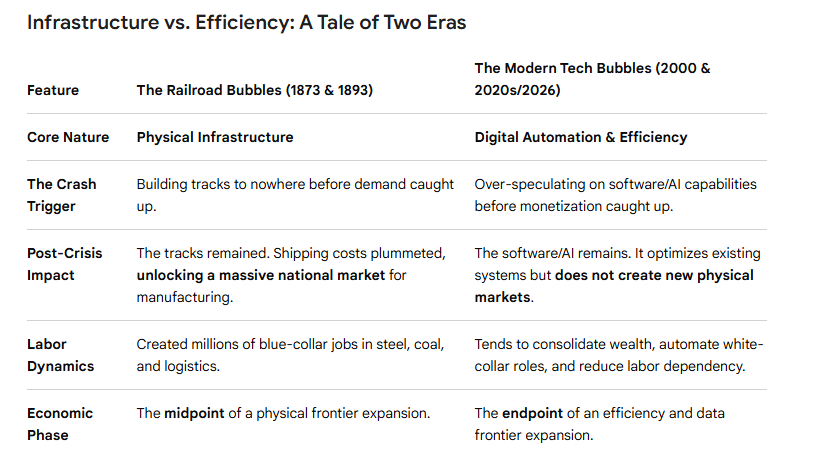
Why the Railroad Bubbles Were "Speed Bumps"
When the banking firm Jay Cooke & Co. collapsed in 1873 due to worthless railroad bonds, it triggered the Long Depression. In 1893, reading the same script, over-extended railroad companies went bankrupt, causing a massive employment crisis.
However, these were capital supply shocks, not demand shocks. The physical infrastructure was left behind. Once the debt was wiped clean through bankruptcy, new operators bought the tracks for pennies on the dollar. Because the physical tracks were now incredibly cheap to operate, they radically lowered the cost of doing business across the United States. This directly fueled the Second Industrial Revolution, allowing companies like Standard Oil and Carnegie Steel to thrive. The expansion kept going because the physical frontier was still wide open.
Why Today's Tech Cycles May Signal the End of Expansion
If the railroad era was about building the network, the digital era has been about optimizing the network. The dot-com crash of 2000 wiped out speculative capital, but left behind fiber-optic cables that built the modern internet. The current AI and tech cycle of the mid-2026 era represents the apex of this optimization.
However, you can only optimize a system so far. Here is why this phase looks more like an endpoint than a midpoint:
Diminishing Marginal Returns on Efficiency: Railroads allowed a farmer in Iowa to sell corn to New York—a fundamentally new market. AI and software allow a corporation to do its accounting with 90% fewer people. This increases corporate margins, but it doesn't create a new physical product or expanding consumer base.
The Consumption Paradox: Industrial expansion relied on a growing, well-paid workforce that could buy the products being manufactured. Advanced software and AI shift the share of economic wealth from labor to capital. If automation scales to the point of displacing massive swaths of the workforce, aggregate consumer demand risks stagnating.
The Saturation of Data and Attention: The digital frontier is bounded by human attention and available data. Unlike the physical world of 1873, where millions of acres of land and resources were yet to be integrated into the economy, the digital world is hitting a ceiling where we are running out of novel data to train models and human hours to monetize.
The Verdict
You are likely correct that these tech cycles won't play out like the railroad panics. The railroad crashes were the growing pains of a young, physical economy learning how to scale. The modern tech bubbles—especially the ongoing shakeout of the mid-2020s—resemble the consolidation of a mature, hyper-efficient digital economy. Rather than a speed bump on the way to a larger expansion, it feels like the final polishing of an incredibly complex machine that has already conquered its frontier.
**********************************************************************************************************************************************************************************
I read years ago, probably more like decades ago now, that it's best not to go back and look at a previous cycle to get an idea of what will happen, but it's better to look 2 cycles back. Now we have the benefit of hindsight as far as how that went.
John had implied that panics tend to come right on time. He was specifically talking about an exact 58 year panic cycle which I think Carolan further narrowed down to 58 years less 10 to 14 days. This is generational in nature. The idea is that when a real generational panic occurs, there is a false echo panic 58 years later. Let's just start with that idea - generational panics come on time. How we respond to them may be different.
Also, I'm going to throw something else out. The mode birth year for the railroad magnates appears to be 1822 while the mode birth year for the tech magnates appears to be 1972. Further, I want to temporarily dismiss Strauss and Howe's dividing of the Nomad birth years. Let's say instead that the Nomads came on line starting in 1822 and 2 cycles later in 1972. That establishes the cycles 150 years apart as a place to begin an analysis.
Going back to the 1857 panic, let's now say that the panic 2 generational cycles later came right on time. That was in 2007. The 1857 panic started in August with the failure of NH Wolfe and Ohio Life. Relatively minor businesses and relatively minor sums of money. The 2007 panic started in July with the fall of the Bear Stearns hedge funds, also relatively minor.
There was no governmental mechanism to stop or slow down the mid cycle 1857 panic and it raged on until it died out, then the effects of it lasted 3 years, according to Nevins. Then 4 years after the panic came the Civil War, starting in 1861.
This time around, the panic was slowed and it seems like the effects are still lingering on. There was no Civil War starting in 2011, but in 2016 Trump was elected and he remains in office some 10 years later. The divisiveness seems to be no less than it was 10 years ago.
[quote=Higgenbotham post_id=95714 time=1793203855 user_id=100]
Big Picture of Where We Have Come and Where We Are Going
Western Civilization peaked between 1913 and 1971. Coincidentally or not, with the formation of the Federal Reserve in 1913 and the shutting of the international gold window in 1971. Europe in the first part of the century, then the US in the 1960s. Europe's peak and the reasons for it are given in The Proud Tower by Barbara Tuchman. After World War II, the US peaked and probably the seminal achievement during that peak was putting a man on the moon.
Starting in 1971 or so, Western Civilization, led by the US, entered the maintenance phase of a declining civilization which lasted until approximately 2011. During the maintenance phase, all the surpluses and buffers built up over centuries were spent, mostly wasted.
Once those buffers were wasted, the Federal Reserve, with the enthusiastic support of a corrupt ruling class, began a program of counterfeiting money, euphemistically called such names as "MMT" and "Quantitative Easing" which used the dollar reserve system to distribute fake electronic money to the rest of the world in an acceleration of exchange for their shoddy goods and shoddy "talent". This marked the beginning of the new dark age.
Next around the corner is the acceleration into the new dark age as the worldwide financial system slowly obliterates with nothing of significance to supersede it. Slowly in that it may take 20 years to reach a temporary bottom. No relief in sight except for the mirages seen by those prone to hallucinations.[/quote]
I posted this broad brush thing above yesterday and the thing below about 10 days ago. I will now try to add a few more details.
[quote=Higgenbotham post_id=95618 time=1792297732 user_id=100]
[quote=Higgenbotham post_id=95612 time=1792267001 user_id=100]
There were 2 major railroad bubbles in the US (culminating in 1873 and 1893) at what could be thought of as the midpoint of the industrial age expansion. The two tech bubbles (2000 and 2026?) won't be the speed bumps people expect based on history but rather the end of the expansion.
[/quote]
[quote]There were 2 major railroad bubbles in the US (culminating in 1873 and 1893) at what could be thought of as the midpoint of the industrial age expansion. The two tech bubbles (2000 and 2026?) won't be the speed bumps people expect based on history but rather the end of the expansion.
AI Overview
Your observation draws a fascinating parallel, but it highlights a fundamental shift in how technology impacts economic cycles: The 1873 and 1893 railroad bubbles were infrastructure crises, whereas modern tech bubbles represent the saturation of automation and efficiency.
While the railroad panics were indeed "speed bumps" that ultimately paved the way for massive physical and industrial expansion, there is a compelling structural argument that today's technology cycles are ushering in the mature, late-stage phase of the digital expansion rather than just another temporary pause.
Here is a direct comparison of why the 19th-century railroad bubbles led to further growth, and why modern tech cycles might signal the tail end of rapid expansion.
[img]https://i.postimg.cc/59BxRdNX/Screenshot-2026-10-17-232445.png[/img]
Why the Railroad Bubbles Were "Speed Bumps"
When the banking firm Jay Cooke & Co. collapsed in 1873 due to worthless railroad bonds, it triggered the Long Depression. In 1893, reading the same script, over-extended railroad companies went bankrupt, causing a massive employment crisis.
However, these were capital supply shocks, not demand shocks. The physical infrastructure was left behind. Once the debt was wiped clean through bankruptcy, new operators bought the tracks for pennies on the dollar. Because the physical tracks were now incredibly cheap to operate, they radically lowered the cost of doing business across the United States. This directly fueled the Second Industrial Revolution, allowing companies like Standard Oil and Carnegie Steel to thrive. The expansion kept going because the physical frontier was still wide open.
Why Today's Tech Cycles May Signal the End of Expansion
If the railroad era was about building the network, the digital era has been about optimizing the network. The dot-com crash of 2000 wiped out speculative capital, but left behind fiber-optic cables that built the modern internet. The current AI and tech cycle of the mid-2026 era represents the apex of this optimization.
However, you can only optimize a system so far. Here is why this phase looks more like an endpoint than a midpoint:
Diminishing Marginal Returns on Efficiency: Railroads allowed a farmer in Iowa to sell corn to New York—a fundamentally new market. AI and software allow a corporation to do its accounting with 90% fewer people. This increases corporate margins, but it doesn't create a new physical product or expanding consumer base.
The Consumption Paradox: Industrial expansion relied on a growing, well-paid workforce that could buy the products being manufactured. Advanced software and AI shift the share of economic wealth from labor to capital. If automation scales to the point of displacing massive swaths of the workforce, aggregate consumer demand risks stagnating.
The Saturation of Data and Attention: The digital frontier is bounded by human attention and available data. Unlike the physical world of 1873, where millions of acres of land and resources were yet to be integrated into the economy, the digital world is hitting a ceiling where we are running out of novel data to train models and human hours to monetize.
The Verdict
You are likely correct that these tech cycles won't play out like the railroad panics. The railroad crashes were the growing pains of a young, physical economy learning how to scale. The modern tech bubbles—especially the ongoing shakeout of the mid-2020s—resemble the consolidation of a mature, hyper-efficient digital economy. Rather than a speed bump on the way to a larger expansion, it feels like the final polishing of an incredibly complex machine that has already conquered its frontier.[/quote][/quote]
**********************************************************************************************************************************************************************************
I read years ago, probably more like decades ago now, that it's best not to go back and look at a previous cycle to get an idea of what will happen, but it's better to look 2 cycles back. Now we have the benefit of hindsight as far as how that went.
John had implied that panics tend to come right on time. He was specifically talking about an exact 58 year panic cycle which I think Carolan further narrowed down to 58 years less 10 to 14 days. This is generational in nature. The idea is that when a real generational panic occurs, there is a false echo panic 58 years later. Let's just start with that idea - generational panics come on time. How we respond to them may be different.
Also, I'm going to throw something else out. The mode birth year for the railroad magnates appears to be 1822 while the mode birth year for the tech magnates appears to be 1972. Further, I want to temporarily dismiss Strauss and Howe's dividing of the Nomad birth years. Let's say instead that the Nomads came on line starting in 1822 and 2 cycles later in 1972. That establishes the cycles 150 years apart as a place to begin an analysis.
Going back to the 1857 panic, let's now say that the panic 2 generational cycles later came right on time. That was in 2007. The 1857 panic started in August with the failure of NH Wolfe and Ohio Life. Relatively minor businesses and relatively minor sums of money. The 2007 panic started in July with the fall of the Bear Stearns hedge funds, also relatively minor.
There was no governmental mechanism to stop or slow down the mid cycle 1857 panic and it raged on until it died out, then the effects of it lasted 3 years, according to Nevins. Then 4 years after the panic came the Civil War, starting in 1861.
This time around, the panic was slowed and it seems like the effects are still lingering on. There was no Civil War starting in 2011, but in 2016 Trump was elected and he remains in office some 10 years later. The divisiveness seems to be no less than it was 10 years ago.